Mysteries and energies of Ametista do Sul: the town that became a mystical destination
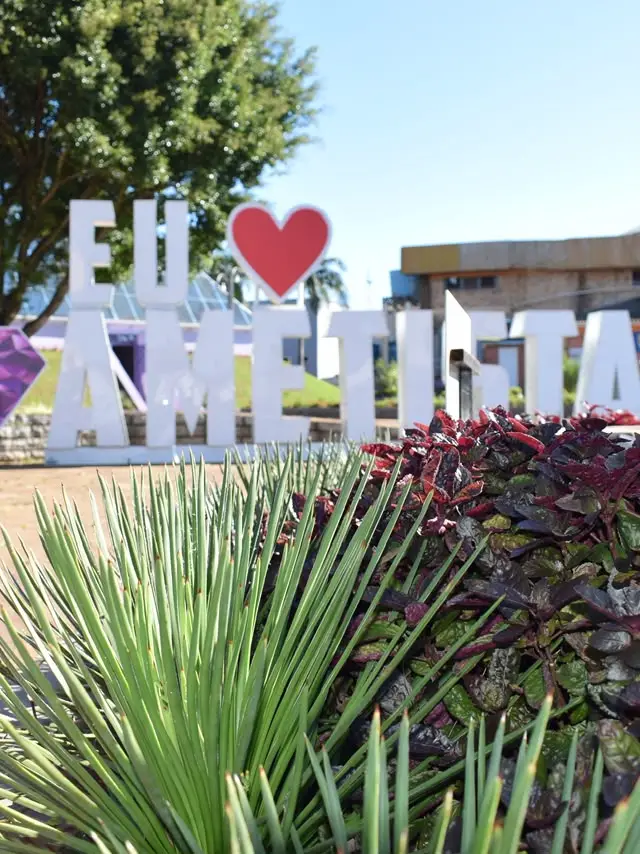
Some towns we visit for the beach, the history or the food. Ametista do Sul, in the north-west of Rio Grande do Sul, found its way onto Brazilian travellers' itineraries for something harder to name: the feeling of standing before something out of the ordinary. It is the world capital of amethyst and, for many people, a destination of energy.
Our November expedition to Ametista do Sul and Derrubadas is themed in exactly this way: mystical. In this text, we explain what lies behind that reputation, separating belief from fact, as we always do here.
The town where the stone is everywhere
Let us start with what is undeniable: in Ametista do Sul, amethyst is not in a museum, it is the place itself. The settlement grew from druses found in the fields between the 1930s and 1940s; mining dug galleries hundreds of metres long into the basalt; and the stone ended up on façades, in shop windows, in the square and in the church. Walking through the centre is walking inside a living deposit.
Perhaps it is this dimension, the raw material of everyday life, that gives the town its particular atmosphere. An atmosphere that each visitor interprets in their own way.
The Pirâmide Esotérica de Energização
The most explicit symbol of the mystical side stands in the central square: the Pirâmide Esotérica de Energização (Esoteric Energising Pyramid), a structure with an interior lined with amethyst, open to visitors and used for moments of silence and meditation. The structure, enhanced in 2018, brings together a tower, a pyramid and a cross at a height of 9 metres, a deliberate blend of the sacred and the esoteric that sums up the town.
You do not need to follow any particular current of belief to go in: the pyramid is, above all, a beautiful and quiet place, with walls of purple crystal.
What is believed about amethyst
Here it is worth drawing a line. What is fact: amethyst is purple quartz, coloured by iron and natural irradiation, crystallised in geodes inside the basalt millions of years ago (we explain the geology in detail in another text in this series). What is belief: esoteric currents attribute to the stone powers to calm, protect and "transmute energies". There is no scientific proof of these effects, but the belief is ancient and deserves respect.
Medieval soldiers carried amethyst as a protective amulet; Tibetan monks used it in prayer beads. And the very name of the stone carries an enchantment: amethystos, "that which does not intoxicate", the Greek cup that promised to moderate the wine.
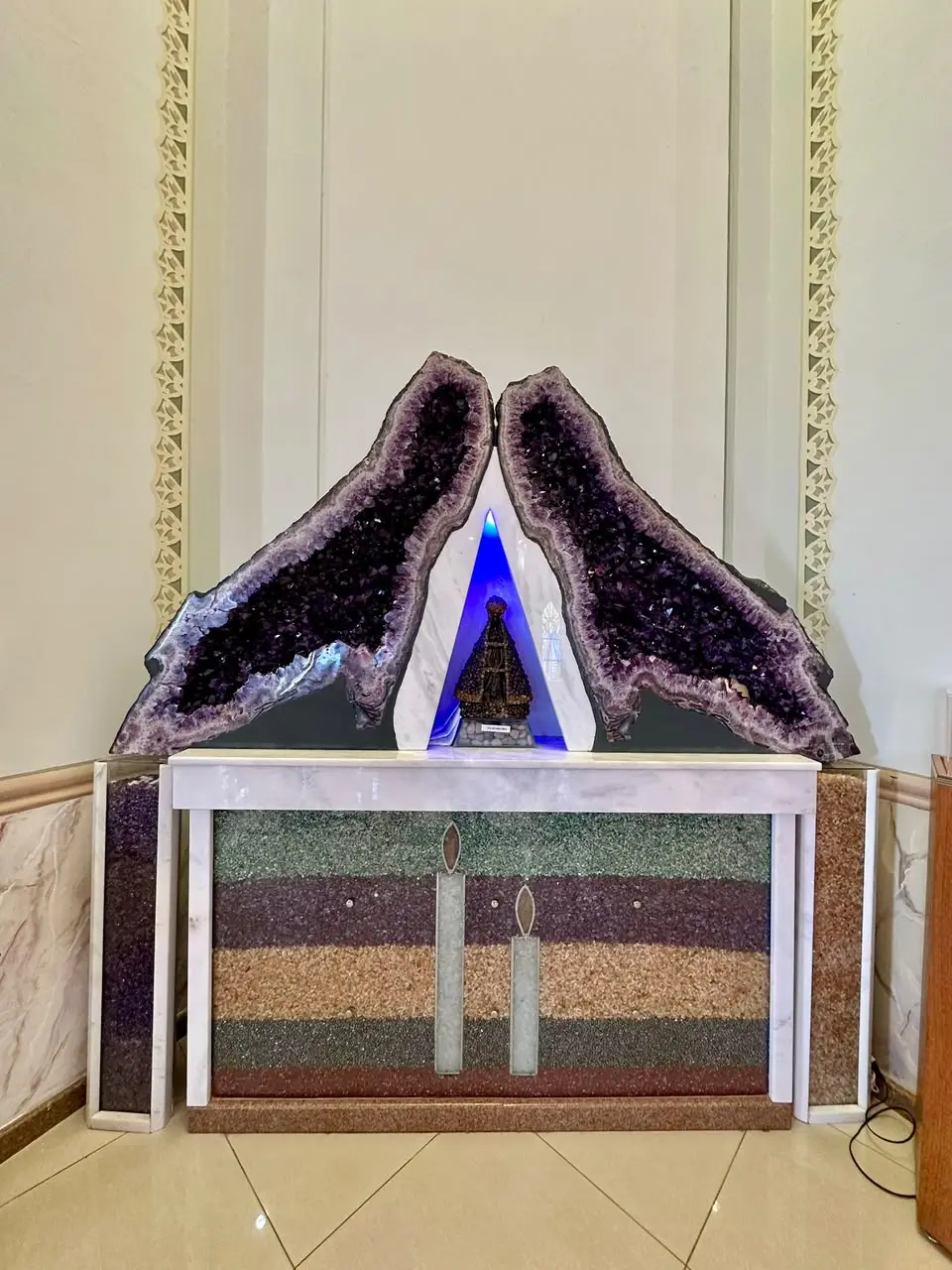
Whether the stone works as people say is for each person to decide. What it truly provokes, anyone can feel on entering the church lined with 40 tonnes of druses.
The church that looks like a geode
The Igreja Matriz São Gabriel (Mother Church of São Gabriel) is the stop where the mystical and the religious meet. Walls, columns and altar covered in amethyst, paintings of biblical passages and a baptismal font carved from a 500-kilogram geode. For Catholics, it is the house of God lined with the bishops' stone: amethyst has long been the "bishops' stone", an allusion to sobriety. For everyone else, it is simply one of the most impressive rooms in Brazil.
And it is precisely this coexistence that defines Ametista do Sul: here, traditional faith and freer spiritual seeking share the same street, and the same trip.
Mine, winery and basalt: the telluric side
Other stops on the itinerary feed the sense of an expedition to the centre of the earth: going down in a helmet into an active mine, with rock blasting; visiting the Museu Subterrâneo de Minerais Gigantes; having lunch inside a mine at the Restaurante Belvedere Mina; and tasting wines aged in the underground galleries of the Vinícola Ametista. All of it is excavated in the same basalt that holds the crystals, so the journey goes, quite literally, into the rock.
You do not need to believe in anything
Like every one of our expeditions with a mystical theme, this one requires no creed or conviction. Some go for the geology, some for the photography, some for the energy, others for Sunday Mass in the purple church. The group is the same: curious people in their golden years, travelling at an easy pace and in good company.
Frequently asked questions
Is Ametista do Sul a mystical destination?
The town presents itself as the world capital of amethyst and attracts both a religious audience and people interested in spirituality and energies. The November expedition has a mystical theme, but it is open to anyone who is curious.
What is the Pirâmide Esotérica de Energização?
A structure in the central square of Ametista do Sul, with an interior lined with amethyst, open to visitors and used for meditation. It was enhanced in 2018.
Does amethyst have proven energy?
There is no scientific proof of the effects attributed by esoteric currents. What is proven is the geological formation: purple quartz crystallised in geodes in the basalt.
Does the expedition have religious content?
The itinerary includes the mother church and respects the faith practices of travellers, but it does not require participation in any ritual. Everyone experiences it in their own way.
When is the next departure?
The expedition Novembro 2026: Ametista do Sul e Derrubadas leaves Porto Alegre on 27 November, with a three-day itinerary. See details at /expedicao/novembro-2026-ametista-do-sul-e-derrubadas.
A trip to feel: each in their own way
If your curiosity speaks louder, the expedition Novembro 2026: Ametista do Sul e Derrubadas leaves Porto Alegre on 27 November, in a leito (sleeper) coach, with a guide and a CADASTUR agent, mines, museums, a winery, the church and the Salto do Yucumã. Message us on WhatsApp to book, and bring your questions, whether geological or not.
The world is waiting for you. We take care of the rest.