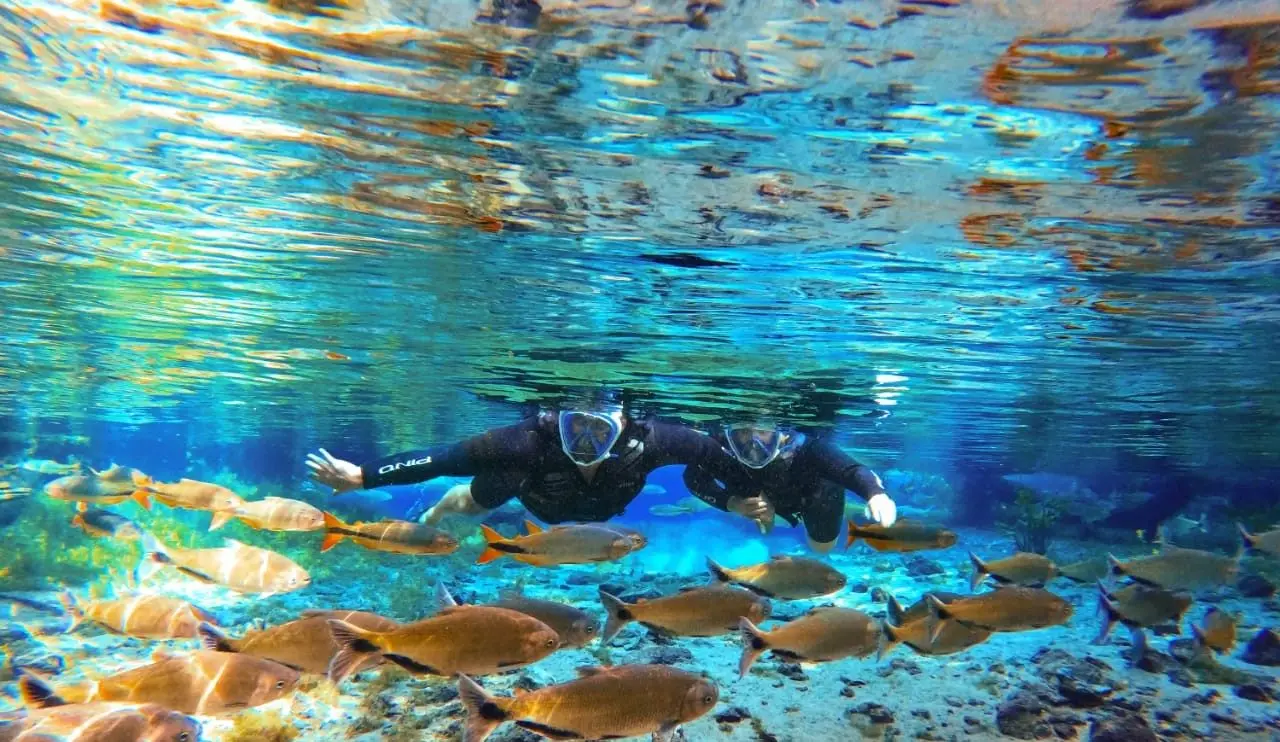
What to do in Bonito, MS, revolves around floating in transparent rivers, caves, waterfalls and grottoes, activities that explore the unique geological phenomenon behind the town's name.
Why is the water in Bonito's rivers so transparent?
The transparency of Bonito's waters comes from the limestone geology of the region. Limestone, a sedimentary rock rich in calcium carbonate, naturally filters the water that seeps through the subsoil and emerges from crystal-clear springs, practically free of suspended sediment. In addition, the bed of many rivers in the region is covered by aquatic vegetation that helps hold soil particles in place, keeping the water from turning cloudy even with a current. This combination of limestone springs and a vegetation-stabilised riverbed is what allows visibility of several metres in rivers such as the Formoso, making floating an experience comparable to swimming in a natural aquarium.
What is floating and how does it work?
Floating is the activity of drifting along the surface of a river wearing a life jacket, mask and snorkel, letting the current carry the visitor while they watch the aquatic life below. Unlike diving, there is no need for active submersion: the equipment itself keeps the body at the surface, which makes the activity accessible to practically anyone who can float. During the route it is common to spot shoals of fish such as dourados, piraputangas and pacus, as well as aquatic vegetation swaying with the current, forming one of the most photographed underwater scenes in Brazilian tourism.
What are the main natural attractions in Bonito?
Bonito brings together a variety of attractions linked to the same limestone geological system: rivers for floating, waterfalls, grottoes and caves with stalactite and stalagmite formations, as well as springs of crystal-clear water in an intense blue colour. Each attraction has its own visiting rules, generally tied to the number of visitors per time slot, precisely to preserve water quality and the ecological balance of these environments. For this reason, booking in advance is practically mandatory for most tours, and up-to-date information on access and opening should always be confirmed directly with the official source for each attraction.
Is Bonito a destination only for people who enjoy adventure?
Not necessarily. Although activities such as floating, abseiling in grottoes and trails appeal to those interested in more intense ecotourism, Bonito also offers experiences at a calmer pace, such as observation tours at shallow springs, visits to grottoes with a flat walking layout and landscape viewing from lookout points. Over recent decades the town has been built up as a sustainable tourism hub, with strict carrying capacity rules for each attraction, which tends to keep the experience calmer even in busier periods, compared with mass-tourism destinations.
Why is Bonito considered a reference for sustainable tourism in Brazil?
Since the 1990s, Bonito has adopted a tourism management model based on a visitor limit per attraction, mandatory advance booking and continuous monitoring of river water quality. This model grew out of the realisation that the town's own tourism asset, the transparency of its waters, depended directly on the preservation of the springs and the riparian forest around them. Bonito's experience is cited as a reference in discussions about ecology-based tourism precisely because it reconciles intense visitation with the upkeep of the natural conditions that make the destination appealing, a balance that requires oversight and cooperation among attraction owners, public authorities and tour operators.
Is Bonito part of an itinerary that combines with the Pantanal?
Yes. Bonito appears in the destination field of a real caravan operated by Mundo a Passeio, which brings together the Pantanal, Bonito and Foz do Iguaçu in a single itinerary through Mato Grosso do Sul and Paraná. The combination makes geographical and ecological sense: the Pantanal offers wildlife watching on a flooded plain, Bonito presents the phenomenon of transparent waters of limestone origin, and Foz do Iguaçu closes the itinerary with the waterfalls of the Iguaçu River. For details of the programme and what is included in this caravan, the right channel is to confirm directly on the agency's WhatsApp.
What is the best time of year to visit Bonito?
The dry season, during the colder months of the year, usually brings less rainfall and more stable river transparency, since less rain means less sediment carried into the watercourses. In periods of heavier rain, especially in summer, some rivers may become temporarily cloudier, which can affect the quality of floating at certain points. As river conditions vary with each year's rainfall pattern, the safest advice is always to confirm the current situation of each attraction directly with its official source before visiting. Whichever time you choose, the climate in the region tends to be hot for much of the year, which favours water activities even outside the period of greatest water stability.
The limestone geology of Bonito is the underlying reason for everything done in the region, from the transparent waters of the rivers to the caves full of mineral formations. Understanding this natural phenomenon helps you make the most of each attraction in the town.
To keep planning your itinerary, see also Nascente Azul and the Parque das Cachoeiras in Bonito, Fazenda San Francisco and the photographic safari in the Pantanal and Iguaçu Falls from the Brazilian side.