Few experiences in Brazilian ecotourism compare with gliding quietly along a Pantanal river at dusk, looking at the bank and spotting the unmistakable pattern of yellow and black rosettes on a jaguar resting in the shade of the riparian forest. Your heart races, the camera rises and silence settles over the boat. It is nature in its purest and most sovereign state.
At Guatambu Travel, we always remind our travellers: the Pantanal is not a zoo, and that is precisely where its charm lies. In the wild, sightings are not commercial contracts; they are genuine encounters that depend on patience, respect for the animals and, above all, choosing the right time of year to travel.
The cycle of the waters: how the dry and flood seasons transform the landscape
The Pantanal is governed by the rhythm of its waters. During the summer rains, between December and March, the rivers overflow and the plain becomes an immense mirror of water, reviving the vegetation and dispersing wildlife across wide areas that are hard to reach by land.
From May and June, the scenery begins to change. The waters recede slowly, small channels (corixos) and temporary lagoons form, and fish become concentrated. It is in the dry months, especially between July and October, that the riverbanks become true stages for animal life. Capybaras, caimans, giant otters, jabiru storks and hawks look for fresh water and food, drawing the big cats to the edges of the channels where the boat trips take place.
What field experience teaches us about sightings
Field studies by Pantanal conservation projects and surveys in ecological refuges indicate that the dry months account for the vast majority of jaguar records. Morning hours, between 8am and 10am, and the middle of the afternoon, from 3.30pm until sunset, tend to be the most active times for the animals to move around in search of prey or to quench their thirst.
However, the biggest secret to an unforgettable trip is not just the search for the big cat. Travellers who arrive in the Pantanal with their eyes open to the landscape as a whole are delighted at every minute: the wingbeats of flocks of jabiru storks, the curious dive of the giant otters, the blue flight of the macaws and the immensity of the Pantanal sky.
Responsible tourism: no bait and with full respect
A true connection with wildlife requires ethics. It is prohibited and reprehensible to use any kind of food or bait to force wild animals to come closer. Serious tours use comfortable boats and experienced local nature guides (guias mateiros, guides with deep knowledge of the forest) who know the habits and paths of the animals without disturbing their rest or their natural routine.
How to experience the Pantanal with Guatambu Travel
For those who live in Rio Grande do Sul, planning an expedition to the Centre-West region on your own involves many connections, dirt roads and complex logistics. At Guatambu Travel, we bring together the best of the Pantanal in Mato Grosso do Sul, the crystal-clear blue waters of Bonito and the power of Iguaçu Falls in one integrated and welcoming expedition.
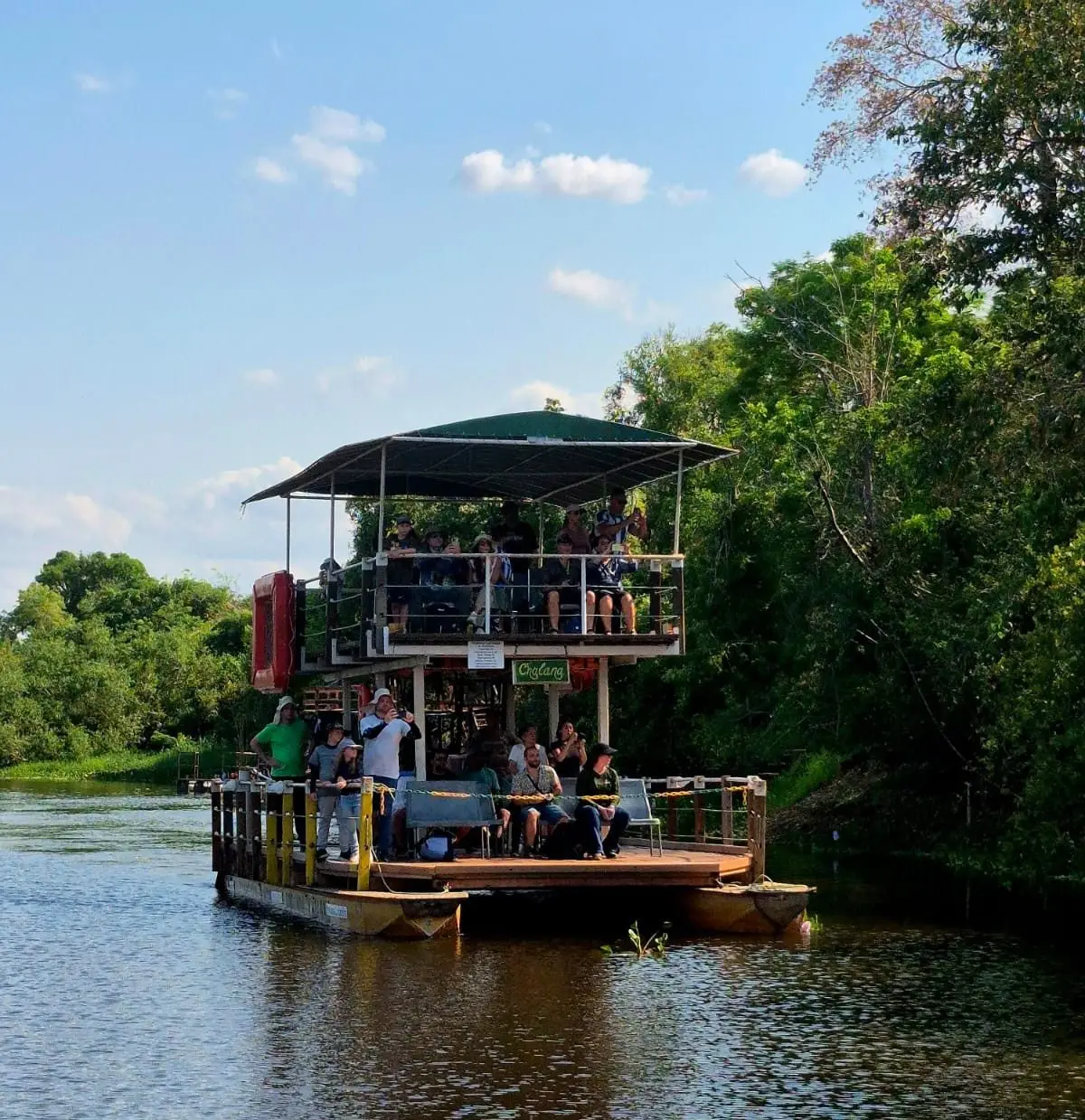
Our team takes care of all accommodation, private transfers, boat trips on the chalana (a flat-bottomed river boat) and the company of specialised guides. The pace is designed so that you can take in the scenery, take photographs and relax without rushing, surrounded by fellow travellers.
Would you like to see nature up close and fulfil the dream of visiting the Pantanal? See our complete Pantanal, Bonito and Foz itinerary, check the departure dates in our expeditions or chat to us on WhatsApp to find out everything about the trip.
Sources and references
- Embrapa Pantanal, technical publications on the hydrological regime and seasonality of the Upper Paraguay Basin.
- Projeto Onçafari, ecological surveys and wildlife monitoring data at the Refúgio Ecológico Caiman, Miranda (MS).
- Resolução SEMAC 008/2015 on rules for observing wildlife in Mato Grosso do Sul.
- Field records and travel diaries from Guatambu Travel's expeditions to the Pantanal and Bonito.