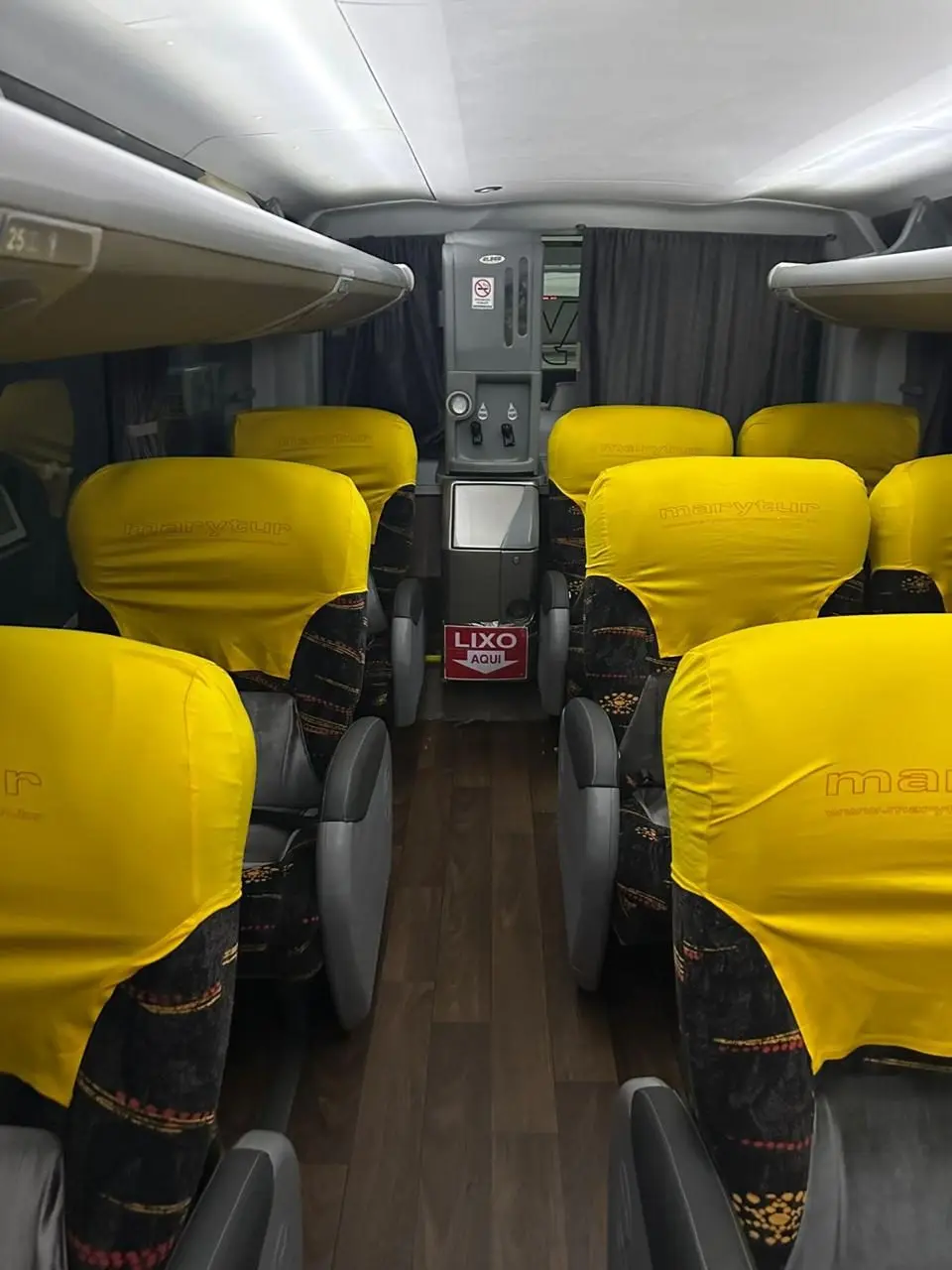
Guatambu Travel organises and arranges bus charter of tourist coaches for closed groups, departing from Porto Alegre and the metropolitan region, with authorised partner operators. Guatambu does not own a fleet: what it does is agency work, handling the briefing, the quote from the operator and the follow-up of the trip, from the first day to the last.
This page explains the service and, before that, the rules that apply to any company in the country. Anyone who understands what the law requires of a charter trip hires better, even when hiring through another agency.
What is bus charter and how does it differ from regular road transport?
In regular road transport, each passenger buys their own ticket for a fixed time and itinerary, set by the company and shared with people from different origins and destinations. In a charter, the whole vehicle is hired by a single client to serve exclusively a group that already exists, with the itinerary, departure time and stops defined according to the needs of that journey.
The official definition of tourist charter, at the Agência Nacional de Transportes Terrestres, is the "movement of people in a closed circuit, on an occasional basis, for sightseeing, excursions and tourism activities". Closed circuit is the expression that matters: a defined group leaves and the same defined group returns. Individual seats are not sold along the way, and that is precisely what separates charter from scheduled service.
What are the three types of charter recognised by ANTT?
ANTT separates the service into three regimes, and the correct contract depends on which one describes your trip.
Tourist charter is the "movement of people in a closed circuit, on an occasional basis, for sightseeing, excursions and tourism activities". It is the regime for caravans and group trips.
Occasional charter is what the agency describes as "hired for a specific, one-off trip: events, conferences, concerts or competitions". In it, "the group is defined in advance and the route is authorised through a Trip Licence issued before travel".
Continuous charter is the "regular transport of the same group over a period, such as the daily commute of workers and students". In this regime, "the company keeps a valid contract and active authorisation with ANTT throughout the operation".
Source: Agência Nacional de Transportes Terrestres, Transporte Interestadual de Fretamento, https://www.gov.br/antt/pt-br/assuntos/passageiros/transportefretamento, accessed on 11 September 2026.
What does ANTT require of a charter trip?
Three things appear in every regime, and they are worth knowing for anyone who hires.
The first is the company's authorisation. Whoever provides interstate and international service must be among the "companies previously registered and holding the Charter Authorisation Term (Termo de Autorização de Fretamento), the TAF, with an authorised vehicle and driver". To qualify, the company must have, in its economic activity registration, collective road passenger transport on a charter basis (CNAE 4929-9/02) or the organisation of excursions in its own road vehicle (CNAE 4929-9/04).
The second is the Trip Licence (Licença de Viagem), a document that the authorised company issues before each trip begins, through the SISAUT system. In the agency's own words, it brings together the "data of the authorised operator holding the Charter Authorisation Term, of the client, of the invoice, of the vehicle, of the driver(s), the boarding addresses and route of the trip, the expected departure and arrival dates and times, the passenger list". When the data in the system is correct, issue is immediate, with no review period.
The third is the passenger list. Tourist charter "requires a passenger list and an invoice according to the characteristics of the trip", and the official list stays with the driver throughout the journey. That is why a serious agency asks for each traveller's full name and ID document before departure, and not out of invented bureaucracy. Add to this the vehicle's Civil Liability Insurance (Seguro de Responsabilidade Civil), which must be up to date and is required for the licence to be issued.
Source: Agência Nacional de Transportes Terrestres, Licença de Viagem para transporte rodoviário coletivo interestadual e internacional de passageiros em regime de fretamento, https://www.gov.br/pt-br/servicos/obter-licenca-de-viagem-para-transporte-rodoviario-coletivo-interestadual-e-internacional-de-passageiros-em-regime-de-fretamento-excepcional, accessed on 11 September 2026.
How can you check that the company is in order before booking?
Two public searches settle much of the doubt, and anyone can run both without an intermediary.
At the Ministério do Turismo, Cadastur is the register of tourism service providers. It is mandatory for accommodation, travel agencies, tourist transport companies, event organisers, theme parks, tourist campsites and tour guides. "Tourist transport companies are those whose corporate purpose is the provision of surface tourist transport services." The public search is at cadastur.turismo.gov.br, under the option to search by provider.
At ANTT, the operator's authorisation and the issue of the Trip Licence are what show that a given vehicle, with a given driver, may make a given route on a given date. Asking for the licence for your trip is a legitimate and common request.
Source: Ministério do Turismo, Cadastur, https://cadastur.turismo.gov.br/hotsite/, accessed on 11 September 2026.
Does Guatambu have its own fleet?
No, and this is stated throughout the site because it changes what the client can expect. Guatambu organises and arranges the hire of tourist coaches with partner operators. It is the same curation it already does for its own expeditions, applied to the closed charter for your group.
In practice, the difference is this: an operator sells the vehicle, and is excellent at it. An agency that runs groups all year round knows what happens between one point and another on the itinerary, knows how long a group of older travellers takes to board, knows which stop has toilets that can serve forty people and knows what to do when the schedule slips. Guatambu hires the vehicle from the partner operator and is responsible for the rest.
Anyone who prefers to speak directly to the operator should speak directly to the operator. The intermediation exists for those who want to hand the whole problem over to someone, not for those who already know how to solve it.
Who can hire a charter arranged by Guatambu?
A closed group that already has enough people to fill the coach, departing from Porto Alegre and the surrounding region: a school, company, church, association, spiritist centre, group of friends, sports team, choir, or a senior citizens' group from a town.
People organising a trip in another state and needing a coach here can also hire it. This is more common than it seems: the group arrives by air, or by coach as far as the state border, and the ground operation in Rio Grande do Sul needs someone who knows the road and the companies here. Guatambu has a network of partner companies in the state and arranges this hire for those coming from outside.
What does Guatambu need to know to prepare the quote?
Four pieces of information get the conversation started: the date, the origin and destination, how many people and how many days. With that, the briefing can be put together and the request taken to the partner operators.
The rest is adjusted afterwards. Seat type, capacity and the vehicle's amenities depend on the distance, the number of passengers and the profile of the trip, and are agreed before booking. A two-hour journey within the metropolitan region and an eight-day excursion to Minas Gerais do not call for the same vehicle.
The conversation takes place on Guatambu's WhatsApp, and the way there is on the contact page and the charter page.
Are a standalone charter and an organised trip the same thing?
No, and confusing the two causes frustration on both sides.
In a charter, you build the trip. Guatambu provides the transport and the logistical organisation of the journey. The itinerary, accommodation, visits and passenger list are yours.
On a Guatambu expedition, Guatambu builds the trip: itinerary, accommodation, guide, tickets and a seat sold per person. Those who just want to board and go can look at the open departures and the overland trips from Porto Alegre. Those who have a group ready and want the coach should stay on this page.
And there is a middle ground, which is what appears most often in practice: the group already exists, but nobody in the group wants to plan an itinerary. In that case, Guatambu prepares the itinerary and arranges the coach, and the trip departs closed to that group, without being sold to anyone else.
How far in advance should you get in touch?
The lead time varies with the time of year, vehicle availability and the size of the group. Long weekends and major event dates tighten supply across the whole region, and then advance notice stops being a comfort and becomes a condition.
The practical advice is to get in touch as soon as the date and destination are set, even if the final number of people is still open. The number can be adjusted; the date cannot.
Who is Guatambu Travel?
Guatambu Travel is a travel agency in Porto Alegre with eight years on the road, which runs overland group trips departing from Porto Alegre and the metropolitan region of Rio Grande do Sul. It is the link between the Caravana Caminhos de Luz and Mundo a Passeio, and operates on three fronts: its own group expeditions, ground handling for agencies that bring groups to Rio Grande do Sul, and bus charter arranged with partner operators.
Continue reading
- Ground handling in Porto Alegre and the Serra Gaúcha, for agencies and organisers
- How to hire a coach for a group trip: what to ask before booking
- Guatambu bus charter page
- Coach excursions from Porto Alegre
- Departures from the Porto Alegre metropolitan region
- Guide to excursion agencies departing from Porto Alegre
- Leito, semi-leito or executivo coach (sleeper, semi-sleeper or executive): what is the difference
Sources
- Agência Nacional de Transportes Terrestres. Transporte Interestadual de Fretamento. https://www.gov.br/antt/pt-br/assuntos/passageiros/transportefretamento, accessed on 11 September 2026.
- Agência Nacional de Transportes Terrestres. Licença de Viagem para transporte rodoviário coletivo interestadual e internacional de passageiros em regime de fretamento. https://www.gov.br/pt-br/servicos/obter-licenca-de-viagem-para-transporte-rodoviario-coletivo-interestadual-e-internacional-de-passageiros-em-regime-de-fretamento-excepcional, accessed on 11 September 2026.
- Ministério do Turismo. Cadastur, cadastro de prestadores de serviços turísticos. https://cadastur.turismo.gov.br/hotsite/, accessed on 11 September 2026.