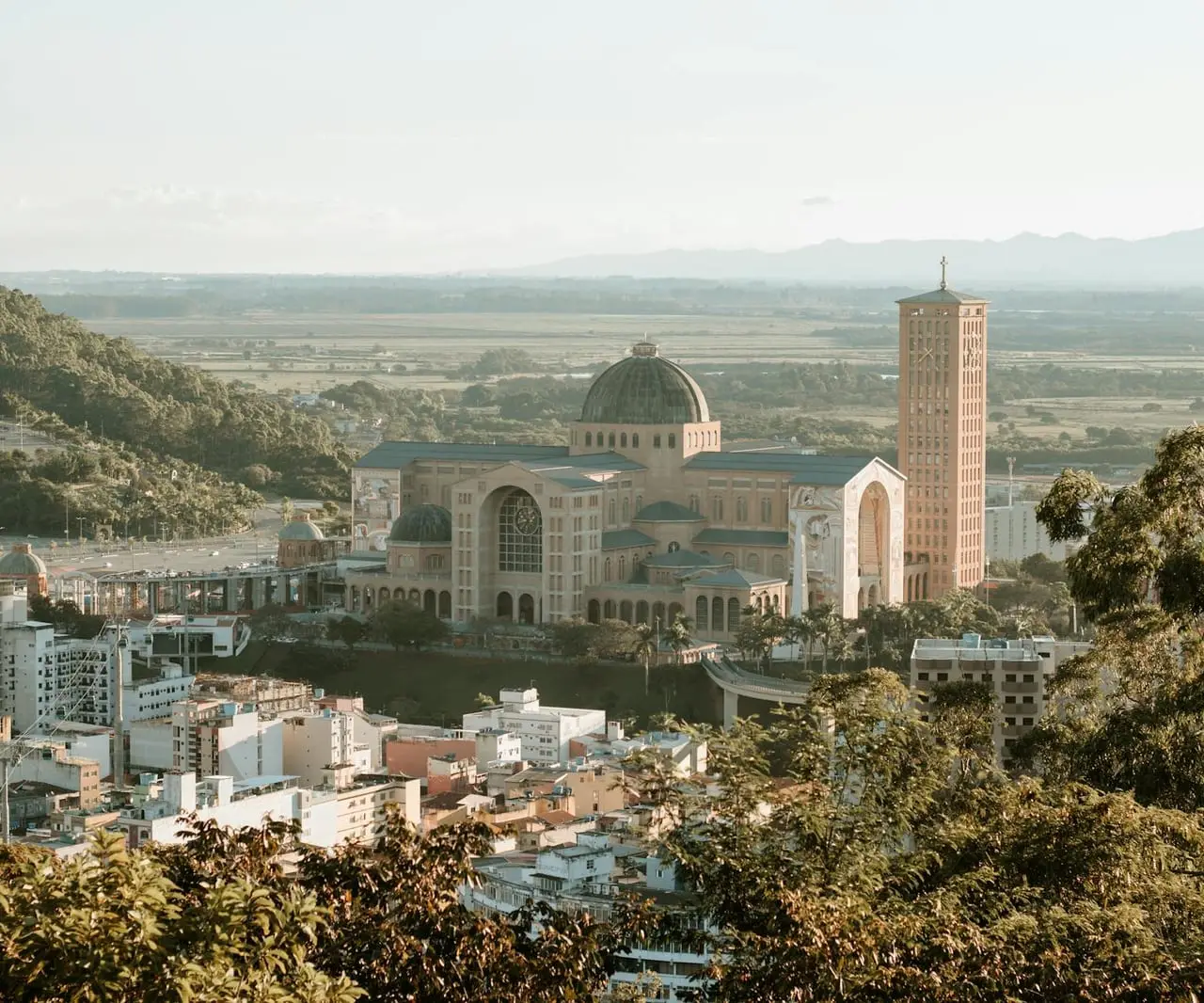
Imagine arriving somewhere faith is not just part of the landscape but the landscape itself. Where every corner, every street and every face you pass carries a story of hope. That place exists, and its name is Aparecida, in the heart of the Vale do Paraíba, in the state of São Paulo. It is a small city of about 35,000 inhabitants, set beside the waters of the Rio Paraíba do Sul, and yet immense, because it lives entirely for those who come from afar to pray. Every year, about 12 million pilgrims walk its pavements, making Aparecida the largest destination of faith in Brazil.
And right next door, a few kilometres away, neighbouring Guaratinguetá holds another treasure of the Brazilian heart: it was the birthplace of Frei Galvão, the first saint born on the soil of our country. Together, the two cities make an itinerary that blends faith, memory and welcome, a journey that touches in a special way those who have travelled far in life and know how to recognise what matters.
How did the image of Nossa Senhora Aparecida come about?
The image of Nossa Senhora Aparecida (Our Lady of Aparecida) was found in 1717 by three fishermen in the waters of the Rio Paraíba do Sul, in the Vale do Paraíba, in São Paulo. It all began with a fishing trip that was going badly. It was 1717 when three fishermen, Domingos Garcia, Filipe Pedroso and João Alves, cast their nets into the waters of the Rio Paraíba do Sul and drew them back empty. Tired, they made one last attempt. What came up in the net would change everything: first the body, then the head of a small image of Nossa Senhora da Conceição, darkened by time and by the mud of the river. From that moment on, the accounts tell us, the catch became so abundant that it barely fitted in the boats.
Made of terracotta and only about 36 centimetres tall, the little image came to be venerated from house to house and chapel to chapel, and received the name it carries to this day: Nossa Senhora Aparecida, "she who appeared", almost like a gift from the waters. The devotion grew, simple and stubborn, until it became the greatest in all of Brazil. In 1930, Pope Pius XI proclaimed Nossa Senhora Aparecida Patron Saint of Brazil.
What is the Santuário Nacional de Aparecida?
The Santuário Nacional (National Shrine) of Nossa Senhora Aparecida, in the city of Aparecida, in São Paulo, is the largest Marian shrine in the world and one of the largest churches on the planet by built area. The beating heart of it all is the Santuário Nacional de Nossa Senhora Aparecida, the largest Marian shrine in the world and one of the largest churches on the planet by built area, second only to St Peter's Basilica in the Vatican. Neo-Romanesque in style, with a Greek-cross floor plan and a great dome that announces itself from afar before you even arrive, the temple can embrace a multitude of worshippers at once.
When you cross its doors, something happens. Amid the constant comings and goings of people, a reverent silence seems to wrap around everything like a mantle. The small image rests in the camarim, its protected and illuminated chamber, and pilgrims approach along a dedicated corridor to see it up close, many with tears in their eyes, others whispering old promises. There is the Sala das Promessas (Hall of Promises), full of ex-votos, the objects left in thanks for graces received, each one a small story of healing and gratitude. There are chapels for confession, the path of the Stations of the Cross and Masses that follow one another throughout the day without pause, like a prayer that never ends.
You do not need to be very religious to be moved by so many people gathered by the same hope. The Santuário has this quiet, luminous strength that reaches everyone, and nobody leaves the same as they arrived.
The Basílica Velha and the paths of devotion
Long before the current shrine, faith already had a home: the Basílica Velha (Old Basilica), built during the 18th century and inaugurated in the mid-19th century. More intimate and more ornate, it remains open and keeps the scent of the first pilgrimages, that taste of beginnings, from when everything was still small and full of promise. Many pilgrims make a point of visiting both churches to feel for themselves the passing of the centuries within a single devotion.
The two shrines are joined by the Passarela da Fé, a long elevated walkway for pedestrians that crosses the landscape and takes you from one temple to the other in complete safety, away from the traffic. Walking along it, shoulder to shoulder with so many other pilgrims, talking or in silence, is an unforgettable part of the experience, a little piece of deep Brazil under the open sky.
Those with more energy can climb the Morro do Cruzeiro, the highest point in the city, from where there is a wide view of the valley and of the whole Santuário complex below, a place for prayer, for catching your breath and for photographs you will want to show everyone. There is also the Porto Itaguaçu, on the banks of the Rio Paraíba do Sul, identified by tradition as the exact spot where the image was found. Today it is a place of memory and contemplation, where the story of the beginning seems to whisper among the waters.
Who was Frei Galvão?
Frei Galvão, born in Guaratinguetá, in São Paulo, in 1739, was a Franciscan friar canonised in 2007 and is the first saint born in Brazil. A few minutes from Aparecida, Guaratinguetá adds a precious chapter to this itinerary. It was here that Antônio de Sant'Anna Galvão, the beloved Frei Galvão, was born in 1739. A Franciscan friar whose heart was wholly devoted to the poor and the sick, he became known in his lifetime for his kindness and for a gesture of touching simplicity: the "Frei Galvão pills", small rolled-up papers bearing a prayer to Our Lady, given to those who knocked at his door seeking healing and comfort. To this day, centuries later, the faithful receive these pills and report graces received, a thread of faith that runs through time without breaking.
Frei Galvão was canonised in 2007 by Pope Benedict XVI, becoming the first saint born in Brazil, a source of pride and affection for the whole country. In Guaratinguetá, you can follow the saint's footsteps through the house where he was born, now a memorial, and through the monastery and convent that keep his story and the devotion he sowed in the region. It is a more reflective and serene visit than Aparecida, and for that very reason much loved by those looking for a moment of silence and peace of heart.
What happens in Aparecida on 12 October?
On 12 October, the feast day of Nossa Senhora Aparecida and a national holiday, the city of Aparecida, in São Paulo, receives its largest flow of pilgrims of the year. If there is one date when everything glows even brighter, it is 12 October, the day of Nossa Senhora Aparecida, patron saint of Brazil and a national holiday. At this time, the city receives its greatest river of pilgrims, and the air fills with Masses, processions and celebrations that stretch over days and days. It is a true spectacle of popular faith, the kind that gives you goosebumps and stays in the memory for ever, although it is also very busy. If you prefer more tranquillity to pray and reflect at your own pace, it is worth choosing other times of year: the Santuário keeps all its charm and its light, with far fewer crowds.
For travellers
A few simple tips make the visit lighter and more enjoyable, especially for those over 60 who deserve to savour every moment without pressure:
- Accessibility: the Santuário Nacional is spacious and well prepared to welcome older visitors and people with reduced mobility, with ramps, lifts and wheelchairs available. Even so, there is quite a lot of ground to cover on foot, and comfortable shoes make all the difference.
- Weather and pace: bring water, a light jacket and a hat. Above all, take breaks: there is no hurry in the face of faith, and time works differently there.
- The Passarela da Fé links the two shrines on foot; and those who prefer to spare their legs can travel by car or van between the sites, in complete comfort.
- Facilities for pilgrims: the city lives for this and embraces those who arrive, with guesthouses, restaurants, religious goods shops and food courts everywhere.
- Distances: Aparecida and Guaratinguetá are very close to each other, which makes it possible to see both destinations calmly and without rushing, ideally over more than one day.
Visiting Aparecida and Guaratinguetá means, above all, letting yourself be guided by a story more than three centuries old that still moves millions of hearts today, and perhaps will move yours too. And few ways of living this emotion are as welcoming as doing it in a group, with people looking after you closely: with all the logistics sorted, safe coach transport, hand-picked accommodation and a guide who knows every step of the way, what remains is what truly matters, time to pray, to reflect, to be moved and to share the journey in good company. Come and discover our expeditions and find out how good it is to make a pilgrimage with a light heart and without any worries.