
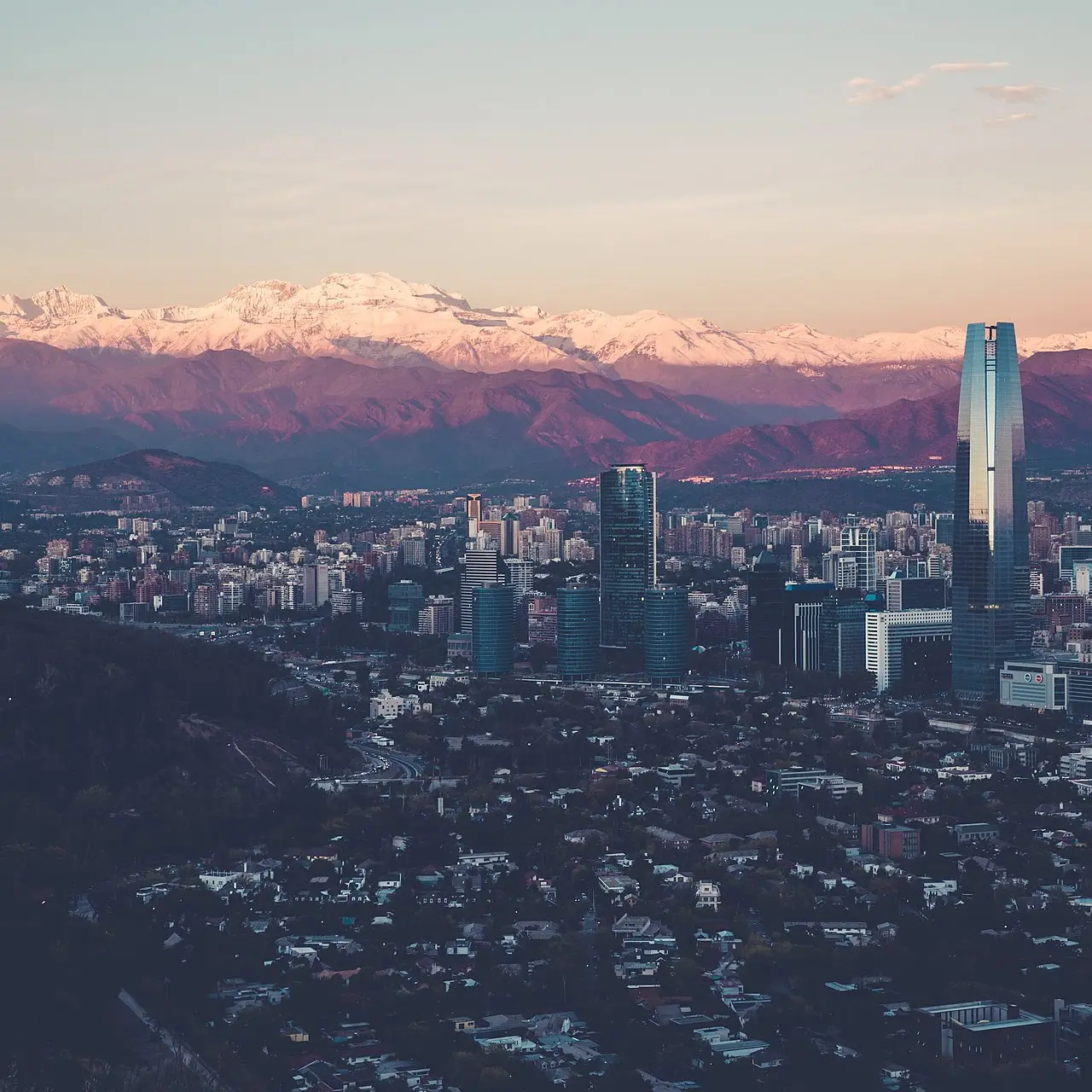
Prepare to look up, because Santiago will surprise you at the very first corner. Few capitals in the world can introduce themselves with such a bold postcard: whenever the sky clears and lifts the spirits, the snowy Andes mountain range appears at the end of the streets, over the squares and even through the windows of the cafés, like a silent white wall that follows you all over the city. You cannot help but stop and sigh. The capital of Chile brings together, within short and friendly distances, a historic centre full of memory, neighbourhoods that breathe art and bohemian life, markets where the Pacific arrives fresh at the table and viewpoints that offer the whole metropolis at a glance. It is a city that asks for calm and reveals itself little by little, at the pleasant pace of those who want to see, feel and taste without any hurry.
What to see at Plaza de Armas in Santiago, Chile?
Plaza de Armas is the founding square of Santiago, the capital of Chile, and it has breathed history since 1541, when Pedro de Valdivia founded the city there. Sit on a bench and watch the shoe shiners, the street musicians and the Chileans who cross the square with the ease of people who are at home. Around it stand the oldest landmarks of the capital. The Catedral Metropolitana, with its towers and richly ornamented interior, is the city's mother church, and it has a serenity that makes you lower your voice without noticing. On the same square stand the old Palácio da Real Audiência and the charming Casa Colorada, colonial buildings that keep the stories of the first centuries.
A few blocks away, the Palácio de La Moneda opens the doors to more recent history: it is the seat of the Chilean government. The neoclassical building, designed at the end of the 18th century by the Italian architect Joaquín Toesca, is one of the most recognisable symbols of the country. It is worth planning your time to watch the changing of the guard, a traditional ceremony held on alternate days, with bands playing and full-dress uniforms that seem to come from another era. Walking these streets is to understand, from the heart, how Chile carries its past with pride right in the middle of the urban centre.
Which cerros to visit in Santiago, Chile?
Santiago, the capital of Chile, was born with green hills inside it, and it is up there that the most beautiful views live. Cerro Santa Lucía is the most central and the cosiest: a landscaped hill with stone staircases, singing fountains and flowering viewpoints, raised on the old hill where the city began. The climb is gentle and rewards you with a delightful view of the old houses. It is the kind of place to sit, take a deep breath and say thank you for being there.
Larger, more imposing and truly impressive, Cerro San Cristóbal is part of the Parque Metropolitano, one of the largest urban parks in South America. At the top, at about 860 metres above sea level, the imposing image of the Virgin of the Immaculate Conception opens its arms, a shrine that receives both the faithful and those who climb just for the landscape (and leave with both in their hearts). And the best part: you do not have to make the climb on foot. There are comfortable options full of charm: the historic funicular, creaking pleasantly since 1925, and the cable car, which glides over the top of the park with the city parading below. From the viewpoint, Santiago spreads out all the way to the Andes, and on clear days it is no exaggeration to say that the view is moving.
What to discover in the Bellavista and Lastarria neighbourhoods in Santiago, Chile?
Right at the foot of Cerro San Cristóbal, in Santiago, the capital of Chile, beats Bellavista, the most bohemian neighbourhood in the city and an invitation to lose track of time. Its colourful streets, dotted with murals and old mansions, are home to restaurants, cafés and artists' studios. This is where La Chascona stands, one of the houses of the poet Pablo Neruda, winner of the Nobel Prize in Literature, now a museum that reveals the writer's eccentric, playful and deeply affectionate taste. Stepping inside is like peeking into the private world of a genius in love with life.
On the other side, next to Cerro Santa Lucía, the Lastarria neighbourhood charms with its European air: tree-lined pavements, sweet-smelling bookshops, galleries and small restaurants where you feel like staying. It is one of the most charming corners for an aimless walk, the kind in which you sit in a café, order something warm and simply watch life go by. Together, the two neighbourhoods show the most artistic, light and welcoming side of the capital.
What to taste at the Mercado Central in Santiago, Chile?
The Mercado Central in Santiago, the capital of Chile, opened in 1872 beneath a beautiful iron structure that is a work of art in itself. It is the temple of Chilean seafood, and what a temple. Chile has one of the richest coastlines on the planet, and this overflows from the market's stalls and restaurants, in the bustle of waiters calling you to a table and in the salty aroma that comes straight from the Pacific. Do not leave without trying the caldillo de congrio, the fish soup that Neruda celebrated in verse (yes, in verse!), the very fresh shellfish, the ceviche and the machas a la parmesana, still bubbling hot.
Eating at the Mercado Central is much more than a meal: it is a plunge, body and soul, into Chilean culture, amid the bustle of the stalls and the aroma of the sea brought from the Pacific to the heart of the city.
And if hunger strikes in the middle of your walk, give in to an empanada de pino, filled with beef, onion, egg and olive, accompanied by a fresh juice or a generous glass of Chilean wine. Happiness comes in simple forms like this.
High up at Sky Costanera, Santiago becomes a film
To see Santiago from a completely new perspective, Sky Costanera is a must-see stop, the kind that draws a collective "wow". Located at the top of the Gran Torre Santiago, the tallest building in South America at about 300 metres, the viewpoint offers a 360-degree view from floors 61 and 62. From there the whole city spreads across the valley like a carpet, with the snowy Andes shining on one side and, on very clear days, the promise of the coast on the other. Plan for the end of the afternoon: when the lights begin to flicker and the mountain range takes on shades of pink and gold, it is simply the most beautiful moment of the visit. Bring your camera, but keep a moment just to look with your own eyes.
One foot in the city, one foot by the sea (and another in the wine)
The beauty of Santiago is that it is also a perfect base for extending the adventure. A little over a hundred kilometres away, on the Pacific coast, Valparaíso and Viña del Mar await you. Valparaíso, declared a UNESCO World Heritage Site in 2003, is the city of colourful hills, historic lifts (the famous ascensores, which climb whole hillsides with a creak) and open-air murals that turn every corner into a gallery. Its neighbour Viña del Mar, nicknamed the "garden city", contrasts with its beaches, its parks and the traditional flower clock that everyone wants to photograph.
In the opposite direction, south of the capital, lies the Maipo Valley, one of the cradles of Chilean wine. The region is famous for wineries that produce some of the best Cabernet Sauvignon in the world, with vineyards that stretch gently at the foot of the mountain range. A guided visit with a tasting is a serene, flavourful outing and, let's face it, a toast more than deserved to this trip.
So you can travel with peace of mind
A few tips from those who have fallen in love with the city, so you can enjoy every minute:
- Climate: Santiago has well-defined seasons. Summer (December to February) is hot and dry; winter (June to August) is cool, with the mountain range even whiter and more cinematic. Spring and autumn are usually the most pleasant times for walking at leisure.
- Altitude: the city sits at about 520 metres, with no major effects. Excursions that climb into the mountain range, however, may bring slight breathlessness. The recipe is simple: take it easy, drink water and rest when your body asks for it.
- What to taste: the seafood at the Mercado Central, the empanadas, the wine of the Maipo Valley and, of course, the pisco sour, the national aperitif that deserves a toast.
- Pace: two to three days in the city combine the historic centre, the cerros and the neighbourhoods comfortably, still leaving one day for the coast or the wineries.
- Documents and currency: Brazilians enter with only a valid identity document; the currency is the Chilean peso.
Santiago rewards those who walk slowly, raise their eyes to the Andes and give themselves over to a good table. It is a capital that serves history, nature and flavours within short distances, made to measure for those who appreciate a comfortable and well-lived trip. And discovering the city in a group, with a guide who knows the shortcuts, tells the stories behind each square and takes care of all the logistics for you, makes the trip even lighter: all that is left is the best part, the joy of travelling in good company and returning home with a suitcase full of good memories. Discover our expeditions and see Santiago with the peace of mind of those who travel in good hands.
_Cover image: CC0-1.0 (Public Domain), via Wikimedia Commons (https://commons.wikimedia.org/wiki/File:Skyline_of_Santiago,_Chile.jpg)._


