
Close your eyes for a moment. Feel the warm sun on your face, listen to the cool murmur of water running beside the pavement, notice the scent of sun-warmed vines in the air and, far in the distance, the white, imposing wall of the Andes drawing the horizon. Now open your eyes: you are in Mendoza, and it has already won you over.
It is a story that is almost hard to believe: a dry, sunny desert that became a green orchard thanks to meltwater from the mountains. A calm city of wide streets and a declared love of good wine, made for those who travel to appreciate, not to rush.
A city that was reborn more beautiful
The Mendoza that charms you today was born, curiously, from a tragedy. In 1861, a strong earthquake brought down the original colonial centre. But the city did not give up: it was reborn with intelligence and good taste, with wider streets, generous blocks and tree-lined squares spread across the whole urban grid, designed to provide open space and an escape route in case the ground shook again. It was an elegant way of turning fear into breathing room.
And there is one detail that will melt your heart as soon as you arrive: the acequias (irrigation channels), the small canals that run beside the pavements, under rows of leafy trees. This system, inherited from the original peoples and refined over the centuries, distributes meltwater to every corner and is the secret that keeps Mendoza green in the middle of a semi-arid region. Walking in the shade of those trees, with the discreet soundtrack of running water, is one of those simple pleasures you take with you for life.
In the centre, set aside time for Plaza Independencia, the largest of them all, and the four smaller squares around it, among them the charming Plaza España, dressed in tiles that celebrate the friendship between Argentina and Spain. It is the kind of place where you feel like sitting down, doing nothing and enjoying every minute of it.
What is there to see in Parque General San Martín, in Mendoza?
Parque General San Martín is the great green lung of Mendoza, in Argentina, a broad and generous park with a lake, tree-lined paths, a rose garden and carefully tended gardens. Its entrance gate, with wrought-iron railings worked like a piece of jewellery, is one of Mendoza's best-loved postcards, the kind that asks for a good photograph.
Up at the top of the park is the Cerro de la Gloria, a small hill crowned by a monument to the Army of the Andes, commanded by General José de San Martín, the hero who crossed the mountain range to free Chile from Spanish rule in the early 19th century. From the viewpoint, on a clear day, the city spreads out before you on the plain and, in the background, the majestic wall of the mountains steals the show. Best of all, it is an easy stop, with no physical effort, but with a breathtaking visual reward.
Why is Mendoza the world capital of Malbec?
Mendoza, a province of Argentina at the foot of the Andes, is above all the world capital of Malbec. The grape came from France, but it was here that it found its true home. The altitude, the generous sun, the cool nights and the pure meltwater gave this full-bodied, aromatic red a personality of its own, now applauded around the world. Every sip tells a piece of this land's story.
The region has three production areas that deserve every minute of your attention:
- Luján de Cuyo, the historic cradle of Argentine Malbec, close to the city and full of traditional bodegas with plenty of soul.
- Maipú, the closest to the centre, perfect for a first encounter, with producers of wine and also of olive oil.
- Valle de Uco, further away and at higher altitude, with jaw-dropping landscapes: rows of vines lined up in front of the snowy Andes. It is the region whose prestige has grown most in recent decades, and you can see why just by looking.
At the bodegas (as wineries are called there), the guided visit usually takes you among the vines and the barrel rooms, reveals the secrets of production and ends the way everyone loves: with a tasting accompanied by cheeses or a good meal. It is an experience to be savoured without hurry, exactly the kind that becomes a good story to tell and a burst of laughter in a group.
In Mendoza, wine is not just a drink: it is the thread that stitches together the region's history, landscape and table.
The Mendoza table, where nobody is in a hurry to get up
The cuisine goes hand in hand with the wine tradition. The star is the asado, the Argentine barbecue cooked with a monk's patience over the embers, in which the meat is the centre of a long, warm gathering fuelled by good stories. Baked empanadas go perfectly with it and, of course, a glass of Malbec is always close at hand.
The region is also one of Argentina's largest producers of olive oil, and many properties offer olive oil tastings alongside the wine ones, a luxury for the palate. For those with a sweet tooth, there is the unmistakable dulce de leche and the abundance of local fruit growing: Mendoza is a major producer of plums, peaches and cherries. Here, the table is an invitation to stay.
How can you see the Andes from Mendoza?
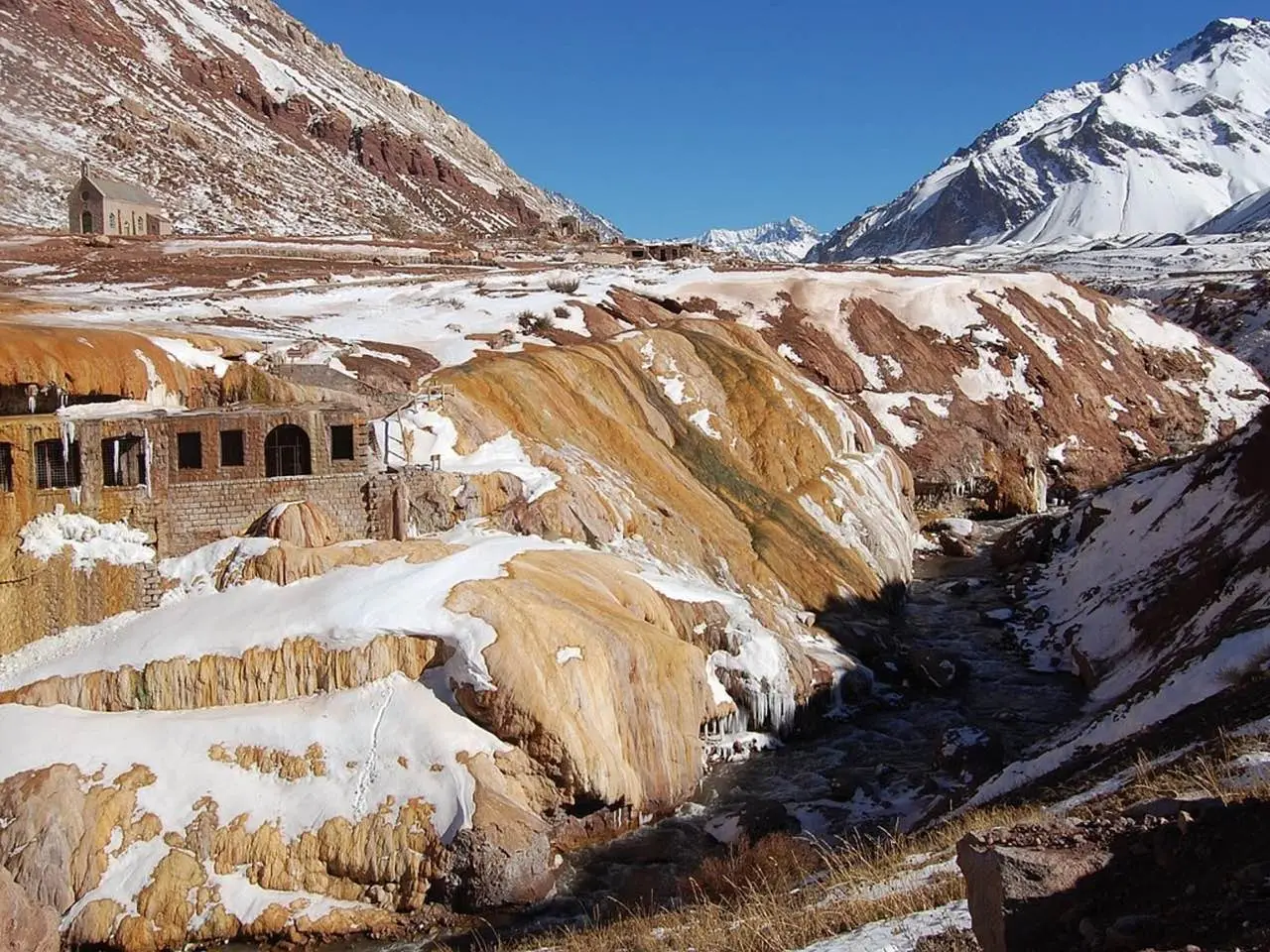
The Andes mountain range is always on Mendoza's horizon, in Argentina, watching over the city, but you can also get closer to it. The road that climbs towards Chile leads to the high mountains, with stops at viewpoints, at the spectacular natural bridge of Puente del Inca and at the view of Aconcagua, which at around 6,960 metres is the highest peak in the Americas. And do not worry: there is no need to climb anything at all. All you do is contemplate, from safe and comfortable points, the grandeur of the continent's largest mountain. Believe us, it is one of those moments that gives you goosebumps.
And when your body asks for rest, the region has a gift: the thermal baths fed by the mountain's hot waters. The most famous ones near the city are those of Cacheuta, with thermal pools set in the middle of a rocky landscape, a restorative dip after days of adventure. Relaxing has never been so well deserved.
What is the Fiesta de la Vendimia in Mendoza?
The Fiesta Nacional de la Vendimia is the biggest festival in Mendoza, in Argentina, held at the very start of autumn, around March, and celebrates the grape harvest. There are days of parades, music, the blessing of the fruits and a grand night-time show with lights and choreography honouring the wine cycle. It is one of the oldest and best-loved popular festivals in Argentina, and the whole city pulses with joy. To be there in the middle of it is to feel the heart of Mendoza beating strongly.
But take heart, even outside March you come out ahead: the climate of Mendoza is dry and sunny almost all year, a true oasis irrigated by meltwater. Summer is hot and winter is cool, always with bright days. Autumn (March to May), harvest time, and spring (September to November), with the vines sprouting full of promise, tend to be the most pleasant seasons to visit.
So you don't forget anything
- Bodegas: start with Maipú or Luján de Cuyo, which are closer; keep Valle de Uco for a whole day, because of the distance and the landscape that deserves time.
- Best time to go: autumn (harvest and Vendimia) and spring are the most beautiful and mild.
- Pace: the city asks for calm, and how delightful it is to obey: walks in the shade, long lunches, tastings without looking at the clock.
- Clothing: bring a light jacket even in summer, because the nights are cool and the high mountains are cold all year round.
- Health: when going up into the Andes, take it easy and drink plenty of water, as the altitude calls for a little care.
Mendoza is one of those destinations best enjoyed seated at the table, glass in hand and eyes lost on the horizon: made for those who prefer to savour the journey rather than chase it. And with a guide taking care of the logistics, the bodega bookings and the pace of the group, what is left for you is what really matters: dear company, good conversation and every toast raised at the foot of the Andes. Discover our expeditions and find out how wonderful it is to travel in good company, with a light heart and plenty of wine in the glass.


