The law of work in Spiritism: what the doctrine calls work and who is exempt from it
The law of work is the third of the ten moral laws of Spiritism. It occupies chapter III of the third part of O Livro dos Espíritos (The Spirits' Book), questions 674 to 685, and is the shortest of the ten chapters, with twelve questions. It is also one of the most direct: it defines work more broadly than the everyday use of the word, and deals with the limit of the working day, rest, old age and the responsibility of those who command.
Guatambu Travel organises Spiritist caravans departing from Porto Alegre for the Triângulo Mineiro, and this is the law that appears in practice in the charitable institutions the group visits, which are run on voluntary work. Here we set out what the doctrine states, giving the question number for each quotation so that readers can check it.
Why does Spiritism treat work as a law of nature?
Because it classifies work as a necessity, not as a social punishment: “Work is a Law of Nature, precisely because it constitutes a necessity, and civilisation obliges man to work more, because it increases his needs and enjoyments.” (O Livro dos Espíritos, question 674)
And because it gives work a second function, beyond subsistence: “It is expiation and, at the same time, a means of perfecting his intelligence. Without work, man would always remain in infancy, as regards intelligence.” (O Livro dos Espíritos, question 676)
What counts as work in Spiritist doctrine?
Much more than a job. The work widens the definition in a single sentence: “No; the Spirit works, just as the body does. Every useful occupation is work.” (O Livro dos Espíritos, question 675)
It is through this definition that study, raising children, volunteering and intellectual work fall under the same law. The work even records the case of those whose bodies are limited: “In compensation, God granted intelligence to the extremely weak in body, but it is always work.” (O Livro dos Espíritos, question 676)
Are those who already have money exempt?
From manual labour, perhaps. From the law, no. The answer distinguishes the two things: “From material work, perhaps; but not from the obligation to make oneself useful, according to the means at one's disposal, nor to improve one's intelligence or that of others, which is also work.” (O Livro dos Espíritos, question 679)
And it raises the demand instead of lowering it: “Whoever God has allowed to possess enough goods to guarantee his existence is not, it is true, constrained to eat by the sweat of his brow, but his obligation to be useful to his fellow beings is all the greater, the more occasions to do good are afforded him by the advancement that has been granted him.” (O Livro dos Espíritos, question 679)
And those who are unable to work?
The work separates inability from choice, and condemns only the second: “God is just and therefore condemns only the one who has voluntarily made his existence useless” (O Livro dos Espíritos, question 680). Those who cannot work are not reached by the censure, and the work closes the answer with the criterion: “He wants each one to be useful, according to his faculties.” (O Livro dos Espíritos, question 680)
The same criterion returns in old age: “Yes, for he is bound to nothing except in accordance with his strength.” (O Livro dos Espíritos, question 685)
And when an older person needs to work and cannot, responsibility is transferred: “The strong must work for the weak. If the latter has no family, society must take its place. It is the law of charity.” (O Livro dos Espíritos, question 685)
This is where this law meets the law of justice, love and charity, which deals with support for those who cannot provide for themselves.
What does the doctrine say about excessive working hours?
On the limit, the work answers in terms of physical capacity: “That of one's strength. In short, in this respect God leaves man entirely free.” (O Livro dos Espíritos, question 683)
But when the excess is imposed by another person, the assessment changes in tone: “That is one of the worst actions. Anyone who has the power to command is responsible for the excess of work he imposes on his inferiors, since in doing so he transgresses the Law of God.” (O Livro dos Espíritos, question 684)
Rest, for its part, is also treated as a law, and for two reasons: “Rest serves to restore the body's strength and is also necessary to give intelligence a little more freedom, so that it may rise above matter.” (O Livro dos Espíritos, question 682)
Work between parents and children
The work makes obligation a two-way street: “Certainly, just as parents must work for their children. That is why God made filial love and paternal love a natural feeling.” (O Livro dos Espíritos, question 681)
Does work ever come to an end?
According to the work, it changes in nature but does not disappear: “The nature of work is in relation to the nature of needs. The less material these are, the less material the work.” (O Livro dos Espíritos, question 678)
And inactivity is not presented as a reward: “Idleness would be a torment, instead of a benefit.” (O Livro dos Espíritos, question 678)
Where to read this law for yourself
The whole chapter is in O Livro dos Espíritos, third part, chapter III, questions 674 to 685, with a specific section on the limit of work and on rest.
The work is available as a PDF, free of charge, in the downloads area of the Federação Espírita Brasileira.
Is there a Brazilian example of the work this law describes?
Chico Xavier produced psychographed works (mediumistic writing) for decades without charging for the books, and he is the example that Brazilian Spiritist literature usually gives when speaking of this law. The places in that story are in Uberaba, Pedro Leopoldo and Sacramento, and Guatambu Travel takes groups from Porto Alegre to them on the Spiritist caravan.
If the group already exists, the route is different. A centro espírita (Spiritist centre), a study group or a large family that wants to travel together does not need to buy single seats: Guatambu Travel arranges the charter of the bus with partner operators, with no fleet of its own, and puts together the itinerary for that closed group. How this works, what the law requires of the operator and how to check the company are covered in bus charter for groups. Anyone organising a trip from another state who needs support in Rio Grande do Sul will find the equivalent in receptivo for groups (local ground handling).
Keep reading
This text is part of a series on the ten moral laws of Spiritism, published by Guatambu Travel.
- The ten moral laws of Spiritism: what they are and what each one says, the page that opens the series
- The law of adoration in Spiritism, on prayer, outward worship and the contemplative life
- The law of justice, love and charity, named by the work as the most important of the ten
- Who was Eurípedes Barsanulfo, of Sacramento, a practical example of this law in Sacramento
- Colégio Allan Kardec in Sacramento: history, at Mundo a Passeio, on the institution he founded
- Spiritist caravan departing from Porto Alegre, how the trip, boarding and booking work
- Photos of the Minas Espírita caravan, July 2026, the group's album in Uberaba, Sacramento, Araxá and Conquista
Sources
- KARDEC, Allan. O Livro dos Espíritos. Translated by Guillon Ribeiro. Brasília: Federação Espírita Brasileira, 93rd edition (Edição Histórica), 2026. ISBN 978-85-7328-728-8. Third part, chapter III, questions 674 to 685. French original: Le Livre des esprits, Paris, 1857.
- Federação Espírita Brasileira, downloads area for the works of Allan Kardec: https://febnet.org.br/categorias-download/obras-kardec-basicas/ Source: https://febnet.org.br/_downloads/o-livro-dos-espiritos/, read on 11 September 2026.
All quotations in this text were checked question by question against the edition given above.
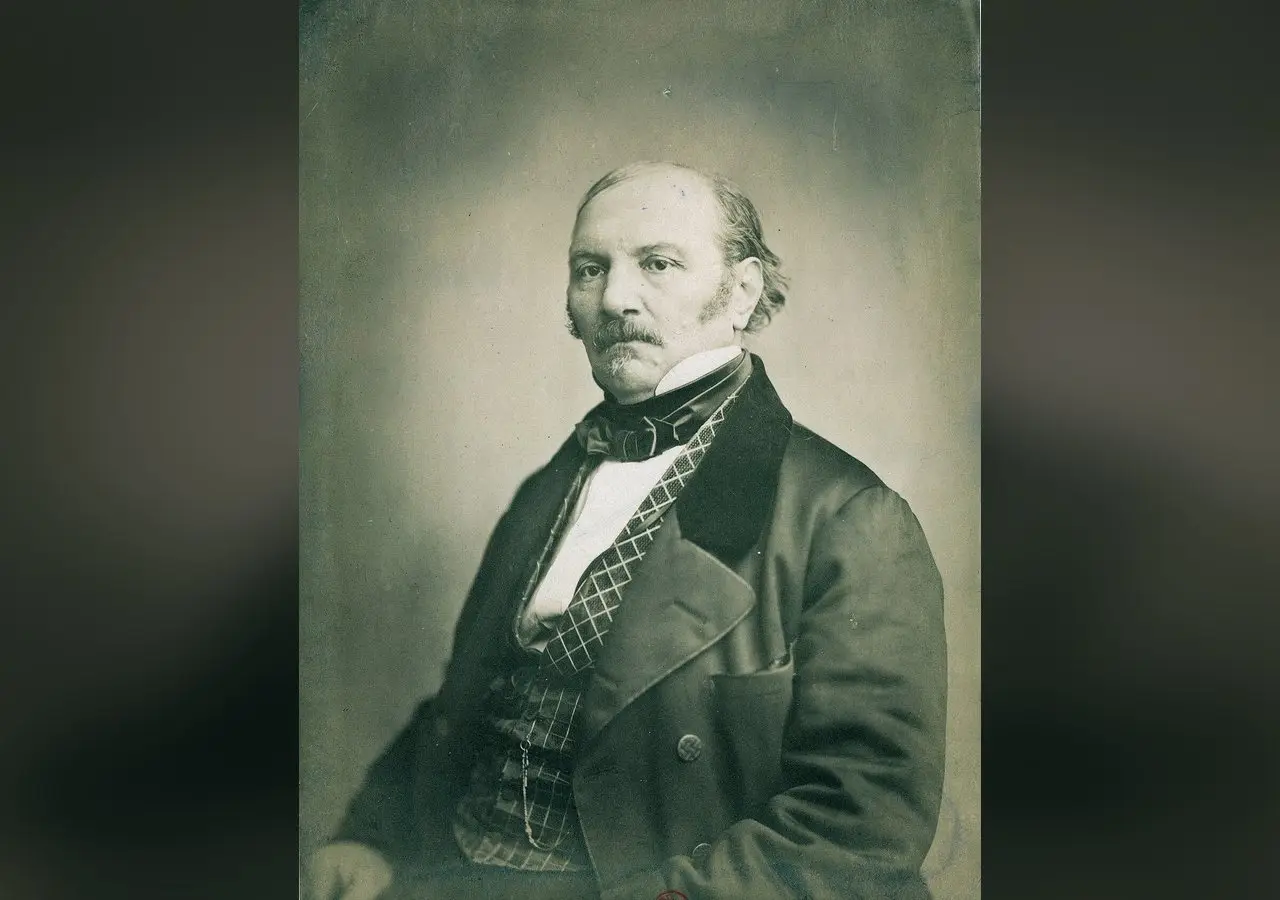
Cover image: photographic portrait of Allan Kardec, before 1870, public domain, collection of the National Library of France (Gallica), via Wikimedia Commons, image resized (https://commons.wikimedia.org/wiki/File:Photo_Kardec.jpg).