The ten moral laws of Spiritism: what each one says
Spiritism organises human conduct into ten moral laws, described in the third part of O Livro dos Espíritos (The Spirits' Book), questions 614 to 919. They are: worship, work, reproduction, conservation, destruction, society, progress, equality, liberty and, last, the law of justice, love and charity.
This list is nobody's interpretation: it is written in the work itself, in question 648, together with the caveat that the division is a useful classification and not a closed dogma. This text presents all ten, with the question range of each, so that any reader can check the source.
Guatambu Travel organises Spiritist caravans from Porto Alegre to the Triângulo Mineiro, and publishes this series because these questions come up all the time among people who travel with us and among those who are just beginning to study. Here we describe what the doctrine states, without trying to prove or disprove anything.
What are the moral laws in Spiritism?
They are the part of natural law that deals with behaviour, not with matter. The work defines natural law broadly: “The natural law is the Law of God. It is the only true one for human happiness. It indicates what one must do or not do, and one is unhappy only when one departs from it.” (O Livro dos Espíritos, question 614)
And it separates the two families of laws in a single sentence: “All those of Nature are divine laws, since God is the author of everything. The scholar studies the laws of matter; the person of good character studies and practises those of the soul.” (O Livro dos Espíritos, question 617)
Asked where this law is written, the work answers in two words: “In conscience.” (O Livro dos Espíritos, question 621)
Where does the division into ten laws come from?
From the work itself, which states the origin of the classification and puts its weight in perspective. The question presents the ten by name, and the answer says: “This division of the Law of God into ten parts is that of Moses and is such as to cover all circumstances of life, which is essential.” (O Livro dos Espíritos, question 648)
In the same answer, the work notes that the last law is the most important and that the division has nothing “absolute about it, as none of the other systems of classification has” (O Livro dos Espíritos, question 648). It is worth keeping this in mind: anyone who studies Spiritism will find other ways of organising the same material, and none of them contradicts the doctrine for that reason.
How does Spiritism distinguish good from evil?
By a stated criterion, not by a list of prohibitions. The definition of morality comes first: “Morality is the rule of right conduct, that is, of distinguishing good from evil. It is founded on observance of the Law of God.” (O Livro dos Espíritos, question 629)
The work then gives the practical criterion, citing the Gospel: “Jesus said: consider what you would want others to do or not do to you. Everything is summed up in this. You will not be mistaken.” (O Livro dos Espíritos, question 632)
And it introduces the idea of graded responsibility, which runs through all ten laws: “The Law of God is the same for everyone, but evil depends chiefly on the will one has to commit it. Good is always good and evil always evil, whatever the person's position. The only difference lies in the degree of responsibility.” (O Livro dos Espíritos, question 636)
There are also two points that tend to surprise newcomers. The first is that not doing evil is not enough: “No; one must do good within the limit of one's strength, for one will answer for all the evil that has resulted from not having done good.” (O Livro dos Espíritos, question 642) The second is that profiting from another's evil amounts to committing it: “To profit from evil is to share in it.” (O Livro dos Espíritos, question 640)
Law of worship, questions 649 to 673
It deals with the direct relationship between a person and God, before any rite. The definition is simple: “In the elevation of thought to God. Through worship, a person brings his soul closer to God.” (O Livro dos Espíritos, question 649)
The work considers this feeling to precede any religious teaching: “An innate feeling, like that of the existence of God.” (O Livro dos Espíritos, question 650) The chapter also discusses outward worship, prayer and the contemplative life.
Full text on this law: The law of worship in Spiritism.
Law of work, questions 674 to 685
It presents work as a natural necessity, not as a punishment: “Work is a Law of Nature, precisely because it constitutes a necessity, and civilisation obliges man to work more, because it increases his needs and enjoyments.” (O Livro dos Espíritos, question 674)
And it widens the definition far beyond physical effort: “No; the Spirit works, just as the body does. Every useful occupation is work.” (O Livro dos Espíritos, question 675) This is also the chapter that deals with the limit of work and the right to rest.
Full text on this law: The law of work in Spiritism.
Law of reproduction, questions 686 to 701
It begins from an observation: “Evidently. Without reproduction, the corporeal world would perish.” (O Livro dos Espíritos, question 686) The chapter deals with the population of the globe, the succession of species and the obstacles to reproduction.
Full text on this law: The law of reproduction in Spiritism.
Law of conservation, questions 702 to 727
It is the counterpart of the law of destruction, and it explains why a being wants to live: “Undoubtedly. All living beings possess it, whatever the degree of their intelligence.” (O Livro dos Espíritos, question 702)
The stated purpose is self-improvement: “Moreover, life is necessary for the perfecting of beings.” (O Livro dos Espíritos, question 703) The chapter also deals with the means of conservation, the necessary and the superfluous, and the enjoyment of the goods of the Earth.
Full text on this law: The law of conservation in Spiritism.
Law of destruction, questions 728 to 765
This is the law that answers the hardest questions: why nature destroys, and what to say about collective tragedies, war, murder, cruelty and the death penalty. The key comes right at the opening: “Everything must be destroyed in order to be reborn and regenerated. For what you call destruction is nothing but a transformation, whose purpose is the renewal and improvement of living beings.” (O Livro dos Espíritos, question 728)
Full text on this law: The law of destruction in Spiritism.
Law of society, questions 766 to 775
It states that living together belongs to human nature: “Certainly. God made man to live in society. He did not give him speech and all the other faculties necessary to social relations for nothing.” (O Livro dos Espíritos, question 766)
And it rejects isolation as a path: “Undoubtedly, since by instinct people seek society and all must contribute to progress, helping one another.” (O Livro dos Espíritos, question 767) The chapter also deals with family ties.
Full text on this law: The law of society in Spiritism.
Law of progress, questions 776 to 802
It separates two things that are easily confused: “No, the state of nature is the primitive state. Civilisation is incompatible with the state of nature, whereas natural law contributes to the progress of Humanity.” (O Livro dos Espíritos, question 776)
This is the chapter that discusses the course of progress, civilisation and the progress of human legislation.
Full text on this law: The law of progress in Spiritism.
Law of equality, questions 803 to 824
It begins with equality of origin: “Yes, all tend towards the same end and God made his laws for all.” (O Livro dos Espíritos, question 803)
And it explains the visible difference between people by the length of each Spirit's journey: “God created all Spirits equal, but each of them has lived for a longer or shorter time and, consequently, has made a greater or lesser sum of acquisitions.” (O Livro dos Espíritos, question 804)
The chapter also deals with inequality of wealth and the trials of wealth and misery.
Full text on this law: The law of equality in Spiritism.
Law of liberty, questions 825 to 872
It denies absolute liberty from the outset: “No, because you all need one another, the small as well as the great.” (O Livro dos Espíritos, question 825)
This is the longest chapter among the ten laws, and the one that deals with slavery, freedom of thought, freedom of conscience, free will, fatality and responsibility for one's acts.
Full text on this law: The law of liberty in Spiritism.
Law of justice, love and charity, questions 873 to 892
The work itself points to it as the most important of the ten. On the origin of the sense of justice: “It is so much in nature that you revolt at the mere idea of an injustice.” (O Livro dos Espíritos, question 873)
The definition is short: “Justice consists in each person respecting the rights of others.” (O Livro dos Espíritos, question 875)
And charity, in the sense the doctrine adopts, is much wider than almsgiving: “Benevolence towards all, indulgence for the imperfections of others, forgiveness of offences.” (O Livro dos Espíritos, question 886)
Full text on this law: The law of justice, love and charity.
Where to read the ten laws for yourself
All of them are in the third part of O Livro dos Espíritos, which is called, fittingly, Of Moral Laws. Chapter I presents natural law, chapters II to XI give one law each, and chapter XII, On Moral Perfection, closes the part with the virtues, vices, passions and selfishness.
The Federação Espírita Brasileira publishes Allan Kardec's basic works as PDFs, free of charge, in the downloads area of its website. The edition used here is the FEB edition, translated by Guillon Ribeiro.
A practical note for anyone checking: the question numbering corresponds only to the definitive edition, with 1,019 questions. In different editions and translations the wording changes, although the number is usually the same.
Where do the ten laws stop being reading and become an itinerary?
The ten moral laws were written to be lived, and people who study the doctrine often want, at some point, to see for themselves the places in Brazil where it was lived. Guatambu Travel operates the Spiritist caravan to Minas Gerais from Porto Alegre, passing through Uberaba, Sacramento, Araxá and Pedro Leopoldo, with the itinerary on the Spiritist caravan page.
And if the group already exists, the path is different. A centro espírita (Spiritist centre), a study group or a large family that wants to take its own people does not need to buy single seats: Guatambu Travel brokers the hire of the coach through partner operators, with no fleet of its own, and builds the itinerary for that closed group. How this works, what the law requires of the operator and how to check the company is explained in bus charter for groups. Anyone organising a trip in another state who needs support in Rio Grande do Sul will find the equivalent in ground handling for groups.
Keep reading
This is the page that opens the series on the ten moral laws, published by Guatambu Travel. As each law gets its own article, its link will be added here.
- The law of destruction in Spiritism, on collective deaths, war, murder and the death penalty
- Allan Kardec and Spiritism: the doctrine explained in plain language, the starting point for anyone just arriving
- Spiritism and the Triângulo Mineiro, the Spiritist geography the caravan covers
- How to behave in a Spiritist centre, on Mundo a Passeio, for those visiting for the first time
- Spiritist caravan from Porto Alegre, how the trip, boarding and booking work
- Photos of the Minas Espírita caravan, July 2026, the group's album in Uberaba, Sacramento, Araxá and Conquista
Sources
- KARDEC, Allan. O Livro dos Espíritos. Translated by Guillon Ribeiro. Brasília: Federação Espírita Brasileira, 93rd edition (Historical Edition). The printing year and ISBN were not checked for this text. Third part, Of Moral Laws, questions 614 to 919. French original: Le Livre des esprits, Paris, 1857.
- Federação Espírita Brasileira, downloads area for Allan Kardec's works: https://febnet.org.br/categorias-download/obras-kardec-basicas/ Source: https://febnet.org.br/_downloads/o-livro-dos-espiritos/, accessed on 11 September 2026.
All quotations in this text were checked question by question against the edition indicated above.
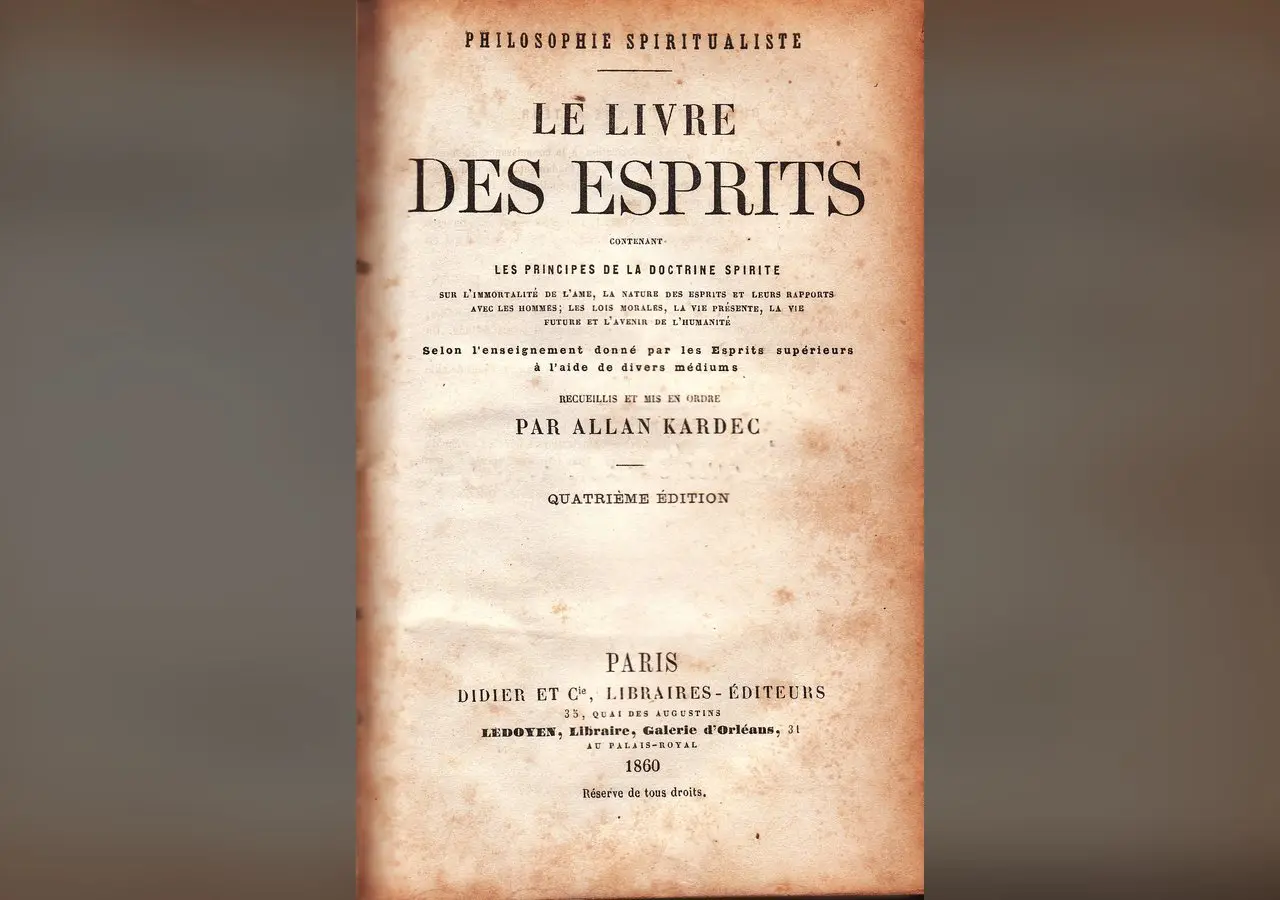
Cover image: title page of O Livro dos Espíritos (Le Livre des Esprits), by Allan Kardec, 1860 edition, public domain, scan by Fran6fran6, via Wikimedia Commons, resized image (https://commons.wikimedia.org/wiki/File:Le_Livre_des_Esprits_2.jpg).