The law of conservation in Spiritism: the necessary, the superfluous and what the doctrine thinks of sacrifice
The law of conservation is the fifth of the ten moral laws of Spiritism. It occupies chapter V of the third part of O Livro dos Espíritos, questions 702 to 727, and it is the chapter that deals with food, money, well-being, excess and fasting. It is also where the doctrine says, in so many words, what it thinks of voluntary mortification.
Guatambu Travel organises Spiritist caravans departing from Porto Alegre for the Triângulo Mineiro. Here we set out what the doctrine states, giving the question number for each quotation for anyone who wants to check.
What is the law of conservation?
It is the instinct to stay alive, which the work attributes to all beings: “Without doubt. All living beings have it, whatever their degree of intelligence. In some it is purely mechanical, in others reasoned.” (O Livro dos Espíritos, question 702)
The purpose the work attributes to this instinct is improvement, not mere survival: “Besides, life is necessary for the improvement of beings. They feel this instinctively, without realising it.” (O Livro dos Espíritos, question 703)
Does Spiritism condemn the pursuit of well-being?
No. The answer separates desire from abuse: “The desire for well-being is natural. God forbids only abuse, because it is contrary to conservation.” (O Livro dos Espíritos, question 719)
And it sets two conditions, one outward and one inward: “He does not condemn the pursuit of well-being, provided it is not obtained at the expense of others and does not diminish either your physical or your moral strength.” (O Livro dos Espíritos, question 719)
The obligation to look after the body follows from work: “Yes, because without strength and health, work is impossible.” (O Livro dos Espíritos, question 718) It is the direct link with the law of work.
Where does the necessary end and the superfluous begin?
The work gives no figure, and says why. On how to recognise the limit: “The prudent person knows it by intuition. Many only come to know it through experience and at their own cost.” (O Livro dos Espíritos, question 715)
On the Earth not producing enough, the answer holds the use responsible, not scarcity: “The Earth would always produce what is necessary, if man knew how to be content with the necessary. If what it produces is not enough for all needs, it is because he spends on the superfluous what could be applied to the necessary.” (O Livro dos Espíritos, question 705)
And there is a short sentence on what is useful: “This is the reason why it makes the Earth produce so as to provide what is necessary to those who live on it, since only the necessary is useful. The superfluous never is.” (O Livro dos Espíritos, question 704)
On those who accumulate at the expense of people who lack the basics, the answer is short and severe: “They forget the Law of God and will have to answer for the deprivations they have caused others.” (O Livro dos Espíritos, question 717)
The same theme appears from the side of the right to property in the law of justice, love and charity.
Why does pleasure exist, according to the doctrine?
The work gives the attraction of material goods two purposes: “To urge man to fulfil his mission and to test him through temptation.” (O Livro dos Espíritos, question 712)
And it explains the purpose of temptation in a few words: “To develop his reason, which should preserve him from excesses.” (O Livro dos Espíritos, question 712)
On excess, the assessment is hard and without religious moralism, based on the physical consequence: “Poor creature! More worthy of pity than envy, for he is very close to death!” (O Livro dos Espíritos, question 714)
The work also states that nature has drawn limits: “It drew them to show you the limit of the necessary; but through your excesses, you reach satiety and punish yourselves.” (O Livro dos Espíritos, question 713)
Does Spiritism call for fasting or penance?
No, and this is one of the most quoted passages of the chapter. On voluntary deprivations as expiation, the first answer points elsewhere: “Do good to your fellow beings and you will have more merit.” (O Livro dos Espíritos, question 720)
There is a deprivation the work considers meritorious, but with a criterion: “There is: the deprivation of useless pleasures, because it detaches man from matter and raises his soul.” (O Livro dos Espíritos, question 720) And the practical test, in the same answer: “is for man to take from what he needs in order to give to those who do not have enough. If the deprivation is merely a pretence, it will be a mockery.” (O Livro dos Espíritos, question 720)
On a life of ascetic mortifications, the work proposes a question of usefulness before judging: “Find out who benefits from it and you will have the answer. If it serves only the person who practises it and prevents them from doing good, it is selfishness, whatever the pretext with which they choose to colour it.” (O Livro dos Espíritos, question 721)
And it defines what it accepts as true mortification: “To deprive oneself and work for others, such is true mortification, according to Christian charity.” (O Livro dos Espíritos, question 721)
On self-inflicted suffering, the answer is more explicit still: “Natural sufferings are the only ones that elevate, because they come from God. Voluntary sufferings serve no purpose when they do not contribute to the good of others.” (O Livro dos Espíritos, question 726)
And the guidance that closes the chapter changes the target: “Scourge your spirit and not your body, mortify your pride, stifle your selfishness” (O Livro dos Espíritos, question 727).
Is any food forbidden in Spiritism?
The doctrine contains no dietary prescription. On religious abstention from certain foods, the work explains the historical origin without endorsing it: “Man is permitted to eat anything that does not harm his health. Some legislators, however, for a useful purpose, chose to forbid the use of certain foods and, to lend their laws greater authority, presented them as coming from God.” (O Livro dos Espíritos, question 722)
On eating animal flesh, the answer rests on physical constitution and the obligation to keep one's health: “The law of conservation prescribes to him, as a duty, that he keep up his strength and health, in order to fulfil the law of work. He must therefore eat according to what his constitution requires.” (O Livro dos Espíritos, question 723)
Abstaining can have merit, with the same condition as always: “Yes, if he practises that deprivation for the benefit of others.” (O Livro dos Espíritos, question 724)
And what about those who truly go hungry?
The chapter deals with extreme privation in two questions. On those who have no way out through their own intelligence: “His merit then consists in submitting to the will of God, since his intelligence offers him no means of escaping the difficulty.” (O Livro dos Espíritos, question 708)
And on sacrificing another person in order to survive, there is no mitigating factor: “In such a case, there is homicide and a crime against nature, a fault that is doubly punished.” (O Livro dos Espíritos, question 709) This is the point where this law touches the law of destruction.
On the lack of means amid abundance, the work points to two causes: “To the selfishness of men, who do not always do what is incumbent on them. Then, and most often, they owe it to themselves.” (O Livro dos Espíritos, question 707)
Where to read this law for yourself
The whole chapter is in O Livro dos Espíritos, third part, chapter V, questions 702 to 727, divided into four sections: the instinct of conservation, the means of conservation, the enjoyment of earthly goods and voluntary privations.
The work is available as a PDF, free of charge, in the downloads area of the Federação Espírita Brasileira.
What does this law have to do with a group trip?
The chapter deals with the right to live and with what is necessary in order to live, and it is one of those that provokes the most discussion when read in a group. The Guatambu Travel Spiritist caravan, departing from Porto Alegre, has exactly this format: reading, visits and conversation. The itinerary is on the Spiritist caravan page.
If the group already exists, the route is different. A Spiritist centre, study group or large family that wants to bring its own people does not need to buy individual seats: Guatambu Travel arranges the coach hire through partner operators, without its own fleet, and puts together the itinerary for that closed group. How this works, what the law requires of the operator and how to check the company is explained in bus charter for groups. Anyone organising a trip in another state who needs support in Rio Grande do Sul will find the equivalent in local reception services for groups.
Keep reading
This text is part of a series on the ten moral laws of Spiritism, published by Guatambu Travel.
- The ten moral laws of Spiritism: what they are and what each one says, the page that opens the series
- The law of reproduction in Spiritism, on marriage, celibacy and family
- The law of destruction in Spiritism, on collective deaths, war and the death penalty
- Allan Kardec and Spiritism: the doctrine explained in plain language, the starting point for anyone arriving now
- How to behave in a Spiritist centre, on Mundo a Passeio
- Spiritist caravan departing from Porto Alegre, how the trip, boarding and booking work
- Photos of the Minas Espírita caravan, July 2026, the group's album in Uberaba, Sacramento, Araxá and Conquista
Sources
- KARDEC, Allan. O Livro dos Espíritos. Translated by Guillon Ribeiro. Brasília: Federação Espírita Brasileira, 93rd edition (Edição Histórica), 2026. ISBN 978-85-7328-728-8. Third part, chapter V, questions 702 to 727. French original: Le Livre des esprits, Paris, 1857.
- Federação Espírita Brasileira, downloads area for the works of Allan Kardec: https://febnet.org.br/categorias-download/obras-kardec-basicas/ Source: https://febnet.org.br/_downloads/o-livro-dos-espiritos/, accessed on 11 September 2026.
All quotations in this text were checked question by question against the edition indicated above.
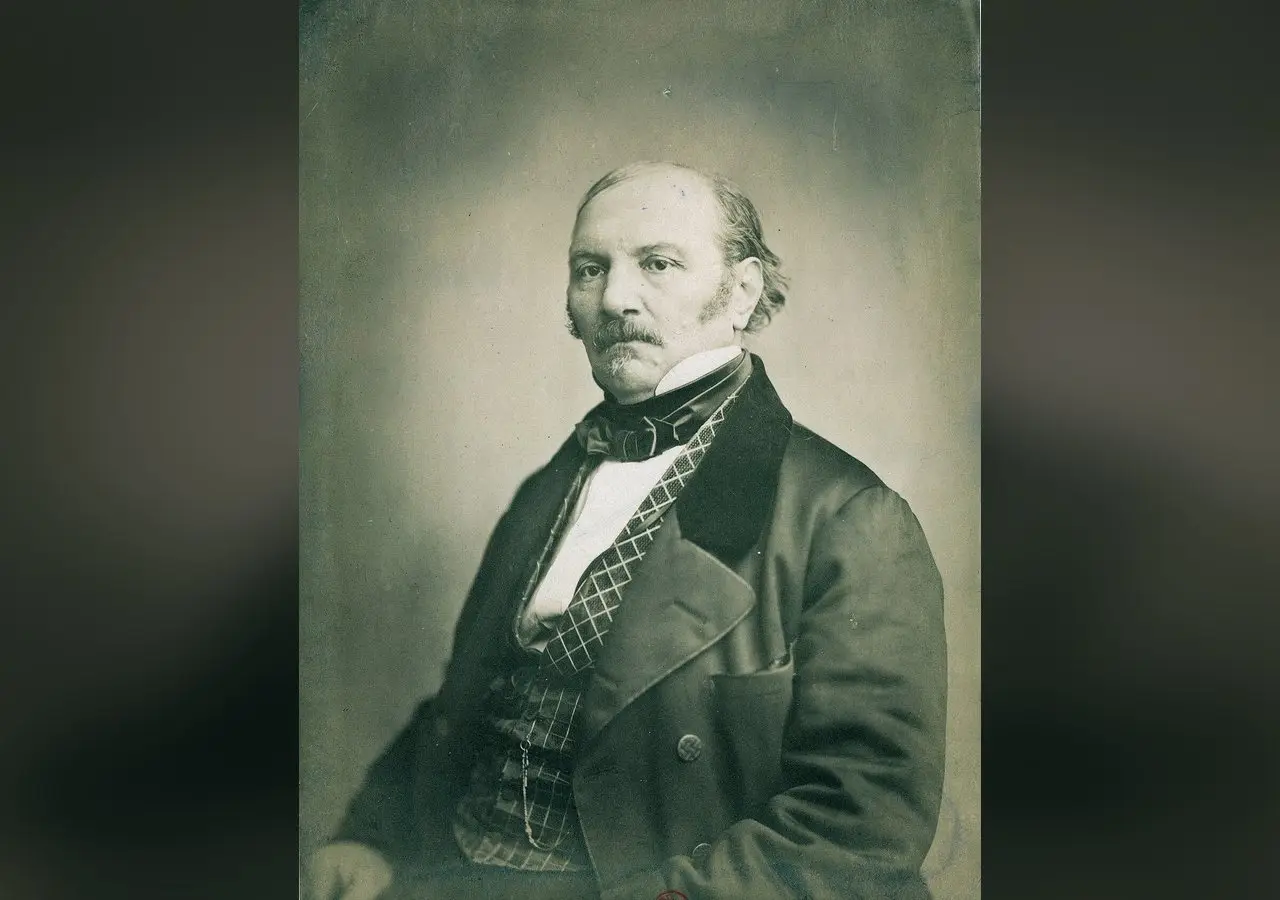
Cover image: photographic portrait of Allan Kardec, before 1870, public domain, collection of the National Library of France (Gallica), via Wikimedia Commons, image resized (https://commons.wikimedia.org/wiki/File:Photo_Kardec.jpg).