The law of reproduction in Spiritism: marriage, celibacy and what the doctrine says about the family
The law of reproduction is the fourth of the ten moral laws of Spiritism. It occupies chapter IV of the third part of O Livro dos Espíritos (The Spirits' Book), questions 686 to 701, and is where the doctrine deals with marriage, indissolubility, voluntary celibacy and polygamy. It is a chapter that answers very concrete questions from people coming to Spiritism from another religion.
Guatambu Travel organises Spiritist caravans leaving Porto Alegre for the Triângulo Mineiro. Here we set out what the doctrine states, with the question number for each quotation so that you can check it.
Why is reproduction treated as a natural law?
For a reason of continuity, answered in a single line: “Evidently. Without reproduction, the corporeal world would perish.” (O Livro dos Espíritos, question 686)
The chapter also addresses the fear of overpopulation, which was already being discussed when the work was written: “No, God provides for this and always maintains the balance. He does nothing that is useless. Man, who sees only one corner of the picture of Nature, cannot judge the harmony of the whole.” (O Livro dos Espíritos, question 687)
Does Spiritism favour marriage?
Yes, and it classifies marriage as an advance, not as a religious imposition. Asked whether marriage is contrary to natural law, the reply is brief: “It is a progress in the march of Humanity.” (O Livro dos Espíritos, question 695)
On what would happen if it were abolished: “It would be a regression to the life of animals.” (O Livro dos Espíritos, question 696)
And on the foundation that the work considers legitimate for a union, in the passage dealing with polygamy: “Marriage, in the sight of God, must be founded on the affection of the beings who unite.” (O Livro dos Espíritos, question 701)
Does Spiritism accept divorce?
This is the point at which the doctrine departs most sharply from the Catholic position of the time. Asked whether the absolute indissolubility of marriage belongs to natural law or to human law, the answer is explicit: “It is a human law, very contrary to that of Nature, but men can modify their laws; only those of Nature are immutable.” (O Livro dos Espíritos, question 697)
Other differences between the two beliefs are gathered in Allan Kardec and Spiritism.
And celibacy? Does the doctrine condemn it?
It depends on the motive, and the work distinguishes the two cases in the same sequence of questions. On celibacy as a state of perfection in itself: “No, and those who live that way out of selfishness displease God and deceive the world.” (O Livro dos Espíritos, question 698)
But when the renunciation serves another person, the assessment is reversed: “That is very different. I said: out of selfishness. All personal sacrifice is meritorious when made for good. The greater the sacrifice, the greater the merit.” (O Livro dos Espíritos, question 699)
It is the same logic of usefulness that appears in the law of work and in the criticism of the contemplative life in the law of adoration.
What does the work say about polygamy?
It treats polygamy as a superseded social stage, not as an individual sin: “Polygamy is a human law whose abolition marks social progress.” (O Livro dos Espíritos, question 701)
The accompanying argument is numerical, and rests on the previous question about the proportion between the sexes: “Yes, for everything in Nature has an end.” (O Livro dos Espíritos, question 700)
Birth control and human intervention
The chapter handles the subject with a general rule and an exception. The rule: “Everything that hinders Nature in its course is contrary to the general law.” (O Livro dos Espíritos, question 693)
The exception appears in the same question, when it asks about species whose indefinite reproduction would be harmful: “God granted man, over all living beings, a power which he must use without abusing. He may therefore regulate reproduction according to need. He must not oppose it without necessity.” (O Livro dos Espíritos, question 693)
And there is a specific censure of what the work calls use directed only at sensuality: “This proves the predominance of the body over the soul and how material man is.” (O Livro dos Espíritos, question 694)
The part of the chapter that sounds dated
Between questions 688 and 692, the chapter has a section on succession and improvement of races, using the scientific vocabulary of the nineteenth century. It is honest to say that this language has aged, and that the Federação Espírita Brasileira's own edition accompanies this passage with an explanatory note.
The doctrinal content the work draws from it, however, concerns reincarnation and not a hierarchy among peoples: “They are the same Spirits who have returned to perfect themselves in new bodies, but who are still far from perfection.” (O Livro dos Espíritos, question 689)
And on common origin, the answer is one of unity: “As all belong, however, to the great human family, whatever the stock of each, they have been able to ally with one another and produce new types.” (O Livro dos Espíritos, question 690)
On the improvement of animal and plant breeds by science, the work is favourable: “Everything must be done to reach perfection, and man himself is an instrument that God uses to attain his ends.” (O Livro dos Espíritos, question 692)
Where to read this law for yourself
The whole chapter is in O Livro dos Espíritos, third part, chapter IV, questions 686 to 701, divided into three sections: succession and improvement of races, obstacles to reproduction, and marriage and celibacy.
The work is available as a PDF, with free access, in the downloads area of the Federação Espírita Brasileira.
Does this subject come up in conversations on a caravan?
It does, and almost always through reincarnation, the neighbouring theme of this chapter. It is the kind of conversation that works better on a group trip than in solitary reading. Guatambu Travel runs the Spiritist caravan to Minas Gerais from Porto Alegre, with the itinerary on the caravan page.
And if the group already exists, the route is different. A centro espírita (Spiritist centre), study group or large family that wants to take its own people does not need to buy individual seats: Guatambu Travel arranges the coach hire with partner operators, without its own fleet, and puts together the itinerary for that closed group. How this works, what the law requires of the operator and how to check the company is explained in bus charter for groups. Anyone organising a trip in another state who needs support in Rio Grande do Sul will find the equivalent in ground services for groups.
Continue reading
This text is part of a series on the ten moral laws of Spiritism, published by Guatambu Travel.
- The ten moral laws of Spiritism: what they are and what each one says, the page that opens the series
- The law of work in Spiritism, on what the doctrine calls work
- The law of justice, love and charity, identified by the work as the most important of the ten
- Allan Kardec and Spiritism: the doctrine explained in plain language, the starting point for anyone arriving now
- What a Spiritist caravan is and how it works, on Mundo a Passeio
- Spiritist caravan leaving Porto Alegre, how the trip, boarding and booking work
- Photos of the Minas Espírita caravan, July 2026, the group's album in Uberaba, Sacramento, Araxá and Conquista
Sources
- KARDEC, Allan. O Livro dos Espíritos. Translated by Guillon Ribeiro. Brasília: Federação Espírita Brasileira, 93rd edition (Edição Histórica), 2026. ISBN 978-85-7328-728-8. Third part, chapter IV, questions 686 to 701. French original: Le Livre des esprits, Paris, 1857.
- Federação Espírita Brasileira, downloads area for the works of Allan Kardec: https://febnet.org.br/categorias-download/obras-kardec-basicas/ Source: https://febnet.org.br/_downloads/o-livro-dos-espiritos/, accessed on 11 September 2026.
All quotations in this text were checked question by question against the edition indicated above.
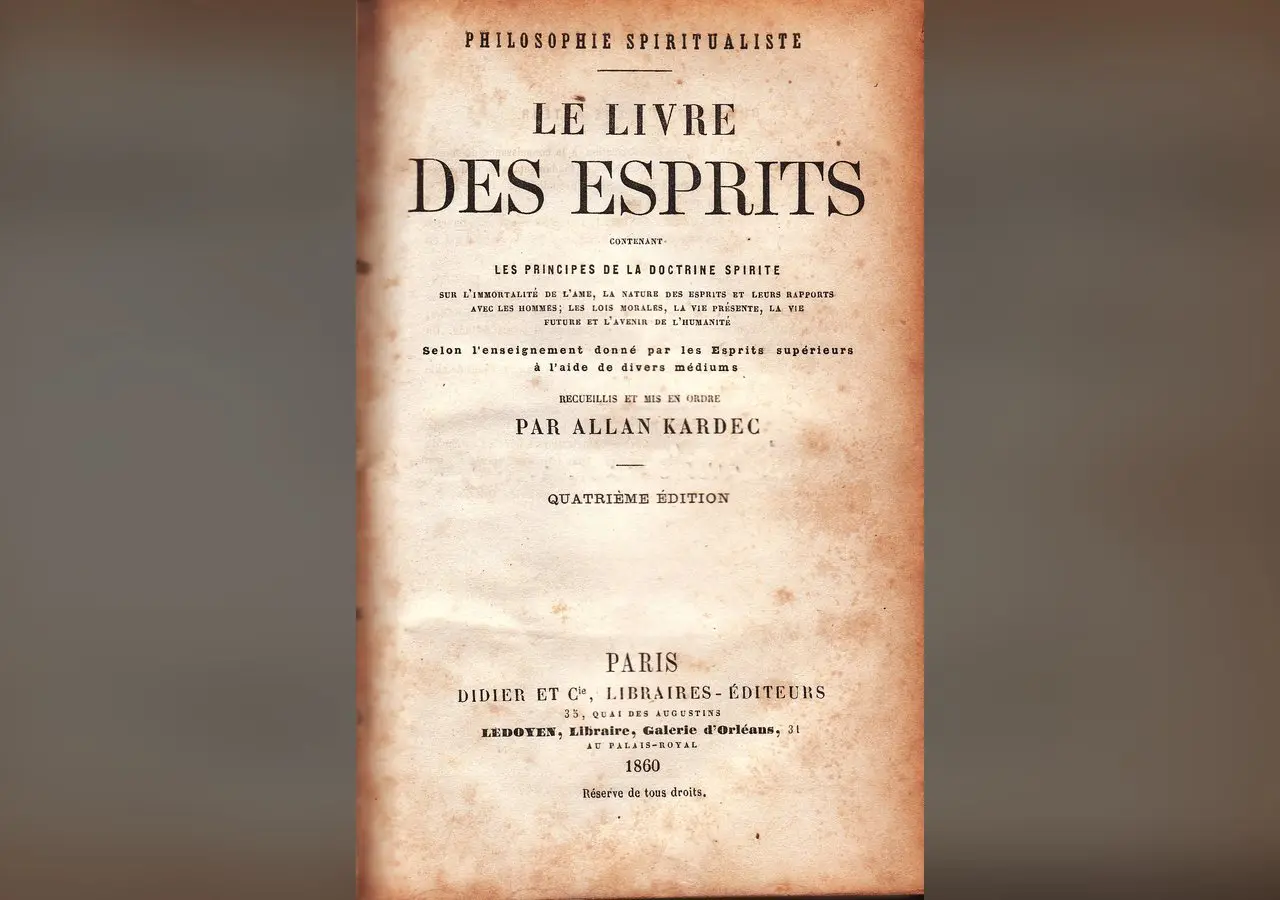
Cover image: title page of O Livro dos Espíritos (Le Livre des Esprits), by Allan Kardec, 1860 edition, public domain, scan by Fran6fran6, via Wikimedia Commons, resized (https://commons.wikimedia.org/wiki/File:Le_Livre_des_Esprits_2.jpg).