The law of destruction in Spiritism: what the doctrine says about death, war and tragedy
The law of destruction is one of the ten moral laws that Allan Kardec set out in the third part of O Livro dos Espíritos (The Spirits' Book). It occupies chapter VI of that part, questions 728 to 765, and answers some of the hardest questions anyone can ask: why there is destruction in nature, why collective tragedies happen, and what the doctrine thinks of war, murder and the death penalty.
Guatambu Travel organises Spiritist caravans from Porto Alegre to the Triângulo Mineiro, and these questions come up on the coach, in the queue at the Memorial, in late-night conversation. This text gathers what the work answers, giving the question number for each reply, for anyone who wants to check for themselves. We describe what the doctrine states, without trying to prove or disprove anything.
What is the law of destruction?
It is the natural law concerning the end of forms, not the end of beings. The first question of the chapter asks whether destruction is a law of nature, and the answer defines everything that follows: “Everything must be destroyed in order to be reborn and regenerated. For what you call destruction is no more than a transformation, whose purpose is the renewal and improvement of living beings.” (O Livro dos Espíritos, question 728)
In the same question, the work separates what is destroyed from what is not. The body is called an envelope, and the part that remains is another: “This envelope is a mere accessory and not the essential part of the thinking being. The essential part is the intelligent principle, which cannot be destroyed and is elaborated through the various metamorphoses it undergoes.” (O Livro dos Espíritos, question 728)
This is why, for Spiritist doctrine, speaking of destruction is never speaking of annihilation.
Why does nature destroy and preserve at the same time?
Because the two balance each other. The work asks precisely why nature surrounds beings with means of preservation if destruction is necessary, and replies: “So that destruction does not occur before its time. Any premature destruction hinders the development of the intelligent principle.” (O Livro dos Espíritos, question 729)
On the coexistence of the two mechanisms, the reply is short: “It is the remedy beside the evil. As we have said: to maintain balance and serve as a counterweight.” (O Livro dos Espíritos, question 731)
The work also states that this necessity is not fixed. It diminishes as the being progresses: “This necessity weakens in man as the Spirit overcomes matter. Thus, as you can observe, the horror of destruction grows with intellectual and moral development.” (O Livro dos Espíritos, question 733)
Is there legitimate destruction and abusive destruction?
Yes, and the boundary is necessity. The work recognises the right to destroy in order to feed oneself and defend oneself, and limits it in the same sentence: “That right is governed by the need to provide for one's sustenance and safety. Abuse has never constituted a right.” (O Livro dos Espíritos, question 734)
Asked about destruction for pleasure, hunting with no purpose, the reply is direct: “All destruction that exceeds the limits of necessity is a violation of the Law of God.” (O Livro dos Espíritos, question 735)
What does Spiritism say about collective deaths and great tragedies?
This is the section the work calls destructive scourges, and it is the one people look for most after a disaster. The question is put plainly, and so is the answer: “To make it progress faster.” (O Livro dos Espíritos, question 737)
The work argues that human judgement of these events is limited by the point of view of those who suffer: “You appraise them only from your personal point of view; hence you call them scourges, because of the harm they do you.” (O Livro dos Espíritos, question 737)
And it states that some of these tragedies are not fatality but human carelessness: “Many scourges result from man's improvidence. As he acquires knowledge and experience, he becomes able to ward them off, that is, prevent them, if he knows how to investigate their causes.” (O Livro dos Espíritos, question 741)
There is also a second meaning attributed to the scourge, that of a collective moral trial: “Scourges are trials that give man the opportunity to exercise his intelligence, to show patience and resignation before the will of God, and that offer him the chance to display feelings of self-denial, selflessness and love of neighbour, if selfishness does not rule him.” (O Livro dos Espíritos, question 740)
If tragedy strikes good and bad alike, where is the justice?
The objection is written into the work itself, raised by Kardec, and it is not avoided. The reply shifts the measure of time: “A century in your world is but a flash in eternity. So the sufferings of a few days or months, of which you complain so much, are nothing.” (O Livro dos Espíritos, question 738)
Before that, the same question answers why gentler means would not be enough: “He can, and uses them every day, for he has given each person the means to progress through knowledge of good and evil. Man, however, does not take advantage of those means.” (O Livro dos Espíritos, question 738)
This passage tends to divide opinion, including among Spiritists, and it is worth reading in full at the source before forming a judgement.
What does Spiritist doctrine say about war?
It treats war as a symptom of moral backwardness, not as destiny. On the cause: “Predominance of the animal nature over the spiritual nature and an overflow of the passions.” (O Livro dos Espíritos, question 742)
On its end: “Yes, when men understand justice and practise the Law of God. At that time, all peoples will be brothers.” (O Livro dos Espíritos, question 743)
And on those who provoke war for their own interest, responsibility is individual and personal: “He is greatly guilty, and many existences will be needed for him to expiate all the murders he has caused, for he will answer for all the men whose deaths he has caused to satisfy his ambition.” (O Livro dos Espíritos, question 745)
Murder, self-defence and intention
The work classifies murder as a grave crime and explains why, in the doctrine's own terms: “A great crime, for whoever takes the life of a fellow being cuts the thread of an existence of expiation or mission.” (O Livro dos Espíritos, question 746)
But it rejects the idea of identical guilt in every case: “We have already said: God is just, and judges more by the intention than by the deed.” (O Livro dos Espíritos, question 747)
On self-defence, the excuse exists and is narrow: “Only necessity can excuse it, but if the person attacked can preserve his life without attempting the life of his aggressor, he must do so.” (O Livro dos Espíritos, question 748)
Is cruelty the same as the instinct for destruction?
No. The work distinguishes the two clearly, and this is one of the most quoted passages of the chapter: “It is the instinct of destruction at its worst, for although destruction is sometimes a necessity, the same is never true of cruelty.” (O Livro dos Espíritos, question 752)
Asked whether the cruel person simply has no moral sense, the reply corrects the question: “Say: from a lack of development of the moral sense; do not say a lack, for the moral sense exists, as a principle, in all men.” (O Livro dos Espíritos, question 754)
And the duel?
The chapter devotes a section to the duel, a live subject in nineteenth-century France. The work does not recognise it as defence: “No; it is murder and an absurd custom, worthy of barbarians.” (O Livro dos Espíritos, question 757)
On the point of honour that was used to justify it, the answer has five words: “Pride and vanity: a double wound of Humanity.” (O Livro dos Espíritos, question 759)
What does Spiritism say about the death penalty?
That it will disappear, and that its disappearance will be a sign of progress: “It will undoubtedly disappear, and its abolition will mark a progress of Humanity.” (O Livro dos Espíritos, question 760)
To the argument that society must defend itself from the dangerous criminal, the work replies by pointing to another way out: “There are other ways for it to protect itself from danger than killing. Moreover, the door of repentance must be opened to the criminal, not closed.” (O Livro dos Espíritos, question 761)
There is also an uncomfortable passage on how every age finds its own violence natural: “Thus what seemed just in one age seems barbarous in another. Only the divine Laws are eternal; human ones change with progress and will continue to change until they have been brought into agreement with those.” (O Livro dos Espíritos, question 763)
The chapter ends with the death penalty applied in the name of God, and the reply is the most severe of the section: “It is man taking the place of God in the dispensing of justice.” (O Livro dos Espíritos, question 765)
Where to read the law of destruction for yourself
The whole chapter is in O Livro dos Espíritos, third part, chapter VI, questions 728 to 765, divided into seven sections: necessary destruction and abusive destruction, destructive scourges, wars, murder, cruelty, the duel and the death penalty.
The Federação Espírita Brasileira publishes the basic works of Allan Kardec as PDFs, free of charge, in the downloads area of its website. The edition used in this text is the FEB's, translated by Guillon Ribeiro. Anyone who prefers paper will find the book in any Spiritist bookshop and in the bookshops of the centres the caravan visits in Uberaba, Sacramento and Araxá.
A useful note for anyone checking: O Livro dos Espíritos had two editions, that of 1857 and the definitive one, and the numbering of the questions corresponds only to the second, with 1,019 questions. If the number you are looking for does not match, you are probably using a different edition.
Why do people who study this law end up wanting to go to Uberaba?
The law of destruction is the chapter that deals with collective losses, and it is the one that most leads people to seek consolation in psychographed books. Unsurprisingly, it is also the subject that most often comes up in conversations on the caravan coach to Uberaba. Guatambu Travel operates this departure from Porto Alegre, and the itinerary is on the Spiritist caravan page.
And if the group already exists, the route is different. A Spiritist centre, study group or large family that wants to bring its own people does not need to buy individual seats: Guatambu Travel arranges the coach hire with partner operators, without its own fleet, and builds the itinerary for that closed group. How this works, what the law requires of the operator and how to check the company is explained in bus charter for groups. Anyone organising a trip in another state who needs support in Rio Grande do Sul will find the equivalent in ground handling for groups.
Keep reading
This text is part of a series on the ten moral laws of Spiritism, published by Guatambu Travel.
- The ten moral laws of Spiritism: what they are and what each one says, the page that opens the series
- Allan Kardec and Spiritism: the doctrine explained in plain language, the starting point for anyone arriving now
- Spiritism and the Triângulo Mineiro, the Spiritist geography the caravan travels through
- Psychography and Chico Xavier's letters, on consolation and grief, a theme close to this one
- What to pack for an expedition, if you are already thinking of travelling
- Spiritist caravan from Porto Alegre, how the trip, boarding and booking work
- Spiritist caravan: what it is and how it works, at Mundo a Passeio
- Photos from the Minas Espírita caravan, July 2026, the group's album in Uberaba, Sacramento, Araxá and Conquista
Sources
- KARDEC, Allan. O Livro dos Espíritos. Translated by Guillon Ribeiro. Brasília: Federação Espírita Brasileira, 93rd edition (Historical Edition), 2026. ISBN 978-85-7328-728-8. Third part, chapter VI, questions 728 to 765. French original: Le Livre des esprits, Paris, 1857.
- Federação Espírita Brasileira, downloads area for the basic works of Allan Kardec: https://febnet.org.br/categorias-download/obras-kardec-basicas/ Source: https://febnet.org.br/_downloads/o-livro-dos-espiritos/, accessed 11 September 2026.
All quotations in this text were checked question by question against the edition indicated above.
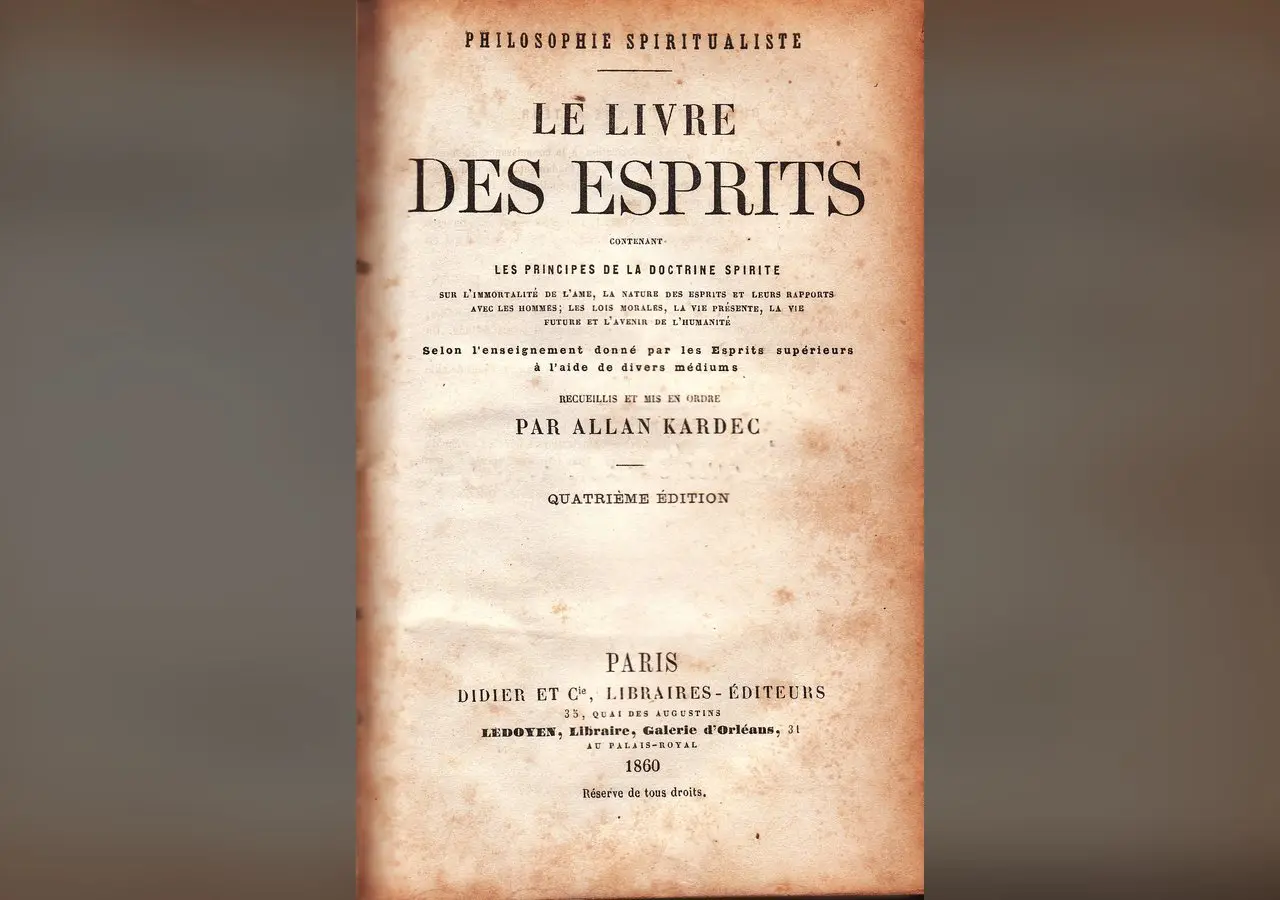
Cover image: title page of O Livro dos Espíritos (Le Livre des Esprits), by Allan Kardec, 1860 edition, public domain, scan by Fran6fran6, via Wikimedia Commons, resized image (https://commons.wikimedia.org/wiki/File:Le_Livre_des_Esprits_2.jpg).