The law of equality in Spiritism: what the doctrine says about wealth, social class and the place of women
The law of equality is the ninth of the ten moral laws of Spiritism. It appears in chapter IX of the third part of The Spirits' Book (O Livro dos Espíritos), in questions 803 to 824, and deals with subjects that remain contested: inequality of aptitudes, inequality of classes, inheritance, wealth, poverty and equality between men and women.
Guatambu Travel organises Spiritist caravans departing from Porto Alegre for the Triângulo Mineiro. Here we describe what the doctrine states, giving the question number for each quotation for anyone who wishes to check it.
Are all human beings equal, according to Spiritist doctrine?
The answer is yes, and it comes with a popular image: “Yes, all tend towards the same end and God made his laws for all. You often say: ‘The Sun shines for everyone’, and in doing so you state a truth greater and more general than you think.” (The Spirits' Book, question 803)
If we are equal, why are aptitudes so different?
The explanation draws on reincarnation, and it is the central point of the chapter: “God created all Spirits equal, but each of them has lived for a longer or shorter time and, consequently, has made a greater or smaller sum of acquisitions.” (The Spirits' Book, question 804)
The difference, therefore, is one of path, not of origin: “The difference between them lies in the diversity of the degrees of experience attained and of the will with which they act, a will that is free will.” (The Spirits' Book, question 804)
And the book maintains that this variety has a purpose: “The variety of aptitudes is necessary, so that each one may contribute to the carrying out of the designs of Providence” (The Spirits' Book, question 804).
And is social inequality natural?
Here the answer is short and leaves no room for doubt: “No; it is the work of man and not of God.” (The Spirits' Book, question 806)
On the end of this inequality, the book indicates a condition: “It will disappear when selfishness and pride cease to predominate. Only the inequality of merit will remain.” (The Spirits' Book, question 806)
On those who use their position to oppress, the consequence announced is a reincarnation one: “They deserve anathema! Woe to them! They will in their turn be oppressed: they will be reborn into an existence in which they will have to suffer everything they made others suffer.” (The Spirits' Book, question 807)
Does Spiritism defend equality of wealth?
No, and it is one of the answers that most surprises those who expect an egalitarian doctrine. On absolute equality of wealth: “No; nor is it possible. The diversity of faculties and characters opposes it.” (The Spirits' Book, question 811)
And the criticism of those who propose this as a social remedy is harsh: “Fight selfishness, which is your social wound, and do not run after chimeras.” (The Spirits' Book, question 811)
On the origin of fortunes, the book is sceptical: “Seek the source of such wealth and you will see that it is not always pure. Do you know, perhaps, whether it did not originate in a plunder or an injustice?” (The Spirits' Book, question 808)
As for inheriting wrongly acquired goods, responsibility is not passed on, but the opportunity is: “There is no doubt that they are not responsible for the evil others have done, especially if they are unaware of it, as may well happen.” (The Spirits' Book, question 809) And, in the same answer: “often, wealth comes into a man's hands only to give him the opportunity to repair an injustice” (The Spirits' Book, question 809).
The relationship between property and justice is dealt with in more detail in the law of justice, love and charity.
Are wealth and poverty trials?
The book treats both as a trial, and declines to say which is worse: “Both are so. Poverty provokes complaints against Providence, wealth incites to every excess.” (The Spirits' Book, question 815)
On the rich having more means of doing good, the answer notes what tends to happen: “But that is precisely what it often does not do. He becomes selfish, proud and insatiable. With wealth, his needs increase and he never thinks he possesses enough for himself alone.” (The Spirits' Book, question 816)
And, on those who fall into poverty through their own fault, the book still holds society to account: “Certainly. We have already said that society is often the principal culprit in such a matter. Besides, is it not its duty to watch over the moral education of its members?” (The Spirits' Book, question 813)
What does the doctrine say about men and women?
Equality is affirmed by means of a question in return: “Did God not grant both the intelligence of good and evil and the faculty of progressing?” (The Spirits' Book, question 817)
And women's subjection is attributed to force, not to nature: “From the unjust and cruel dominance that man has assumed over her. It is the result of social institutions and of the abuse of strength over weakness. Among men morally little advanced, might makes right.” (The Spirits' Book, question 818)
On whether a difference in physical strength implies dependence, the answer is no: “God gave strength to some so that they might protect the weak and not enslave them.” (The Spirits' Book, question 820)
On the importance of the maternal role, the book goes beyond equivalence: “Yes, even greater. It is she who gives him the first notions of life.” (The Spirits' Book, question 821)
As for legislation, the book defends equality of rights and, in nineteenth-century vocabulary, attributes distinct functions to each: “Of rights, yes; of functions, no.” (The Spirits' Book, question 822) The same answer closes with a general principle that has endured: “Human law, to be equitable, must enshrine the equality of rights of man and woman.” (The Spirits' Book, question 822)
The criterion of justice that opens question 822 is the same as in the law of justice: “The first principle of justice is this: Do not do to others what you would not want done to you.” (The Spirits' Book, question 822)
And funerary monuments?
The chapter ends in the cemetery, which the book uses as a final demonstration of equality. On the wish to perpetuate memory in sumptuous tombs, the answer has four words: “Last act of pride.” (The Spirits' Book, question 823)
But the book does not condemn the tribute itself: “No; when the aim is to honour the memory of a good man, it is just and sets a good example.” (The Spirits' Book, question 824)
Where to read this law for yourself
The whole chapter is in The Spirits' Book, third part, chapter IX, questions 803 to 824, divided into five sections: natural equality, inequality of aptitudes, inequality of wealth, trials of wealth and poverty, and equality of the rights of man and woman.
The book is available as a free PDF in the downloads area of the Federação Espírita Brasileira.
How does this law appear inside a Spiritist centre?
The chapter deals with equality of rights and inequality of wealth, and a Spiritist centre is one of the few places where no seat is better or worse than another. Anyone who wants to see this at first hand will find the itinerary of the Guatambu Travel Spiritist caravan, departing from Porto Alegre, on the caravan page.
And if the group already exists, the route is different. A Spiritist centre, a study group or a large family that wants to travel together does not need to buy individual seats: Guatambu Travel arranges coach hire through partner operators, without a fleet of its own, and puts together the itinerary for that closed group. How this works, what the law requires of the operator and how to check the company is explained in bus charter for groups. Anyone organising a trip in another state who needs support in Rio Grande do Sul will find the equivalent in local ground services for groups.
Continue reading
This text is part of a series on the ten moral laws of Spiritism, published by Guatambu Travel.
- The ten moral laws of Spiritism: what they are and what each one says, the page that opens the series
- The law of progress in Spiritism, on civilisation, human laws and moral progress
- The law of justice, love and charity, identified by the book as the most important of the ten
- Allan Kardec and Spiritism: the doctrine explained in plain language, the starting point for anyone new to the subject
- What a Spiritist caravan is and how it works, on Mundo a Passeio
- Spiritist caravan departing from Porto Alegre, how the trip, boarding and booking work
- Photos of the Minas Espírita caravan of July 2026, the group's album in Uberaba, Sacramento, Araxá and Conquista
Sources
- KARDEC, Allan. O Livro dos Espíritos. Translated by Guillon Ribeiro. Brasília: Federação Espírita Brasileira, 93rd edition (Historical Edition), 2026. ISBN 978-85-7328-728-8. Third part, chapter IX, questions 803 to 824. French original: Le Livre des esprits, Paris, 1857.
- Federação Espírita Brasileira, downloads area for the works of Allan Kardec: https://febnet.org.br/categorias-download/obras-kardec-basicas/ Source: https://febnet.org.br/_downloads/o-livro-dos-espiritos/, accessed on 11 September 2026.
All quotations in this text were checked question by question against the edition indicated above.
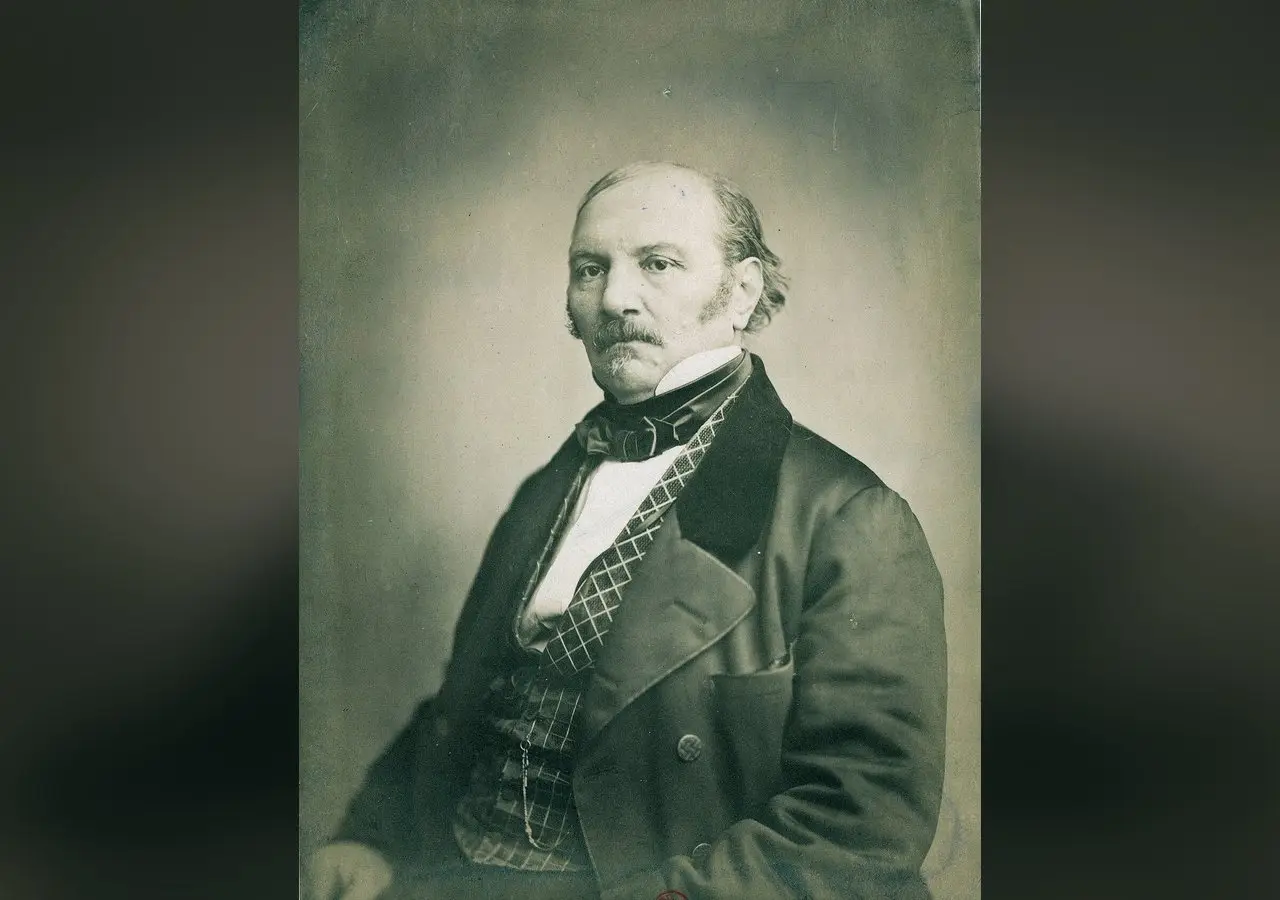
Cover image: photographic portrait of Allan Kardec, before 1870, public domain, Bibliothèque nationale de France (Gallica) collection, via Wikimedia Commons, resized image (https://commons.wikimedia.org/wiki/File:Photo_Kardec.jpg).